
In today’s digital-first world, businesses cannot afford inefficiencies in how they manage internal operations or customer relationships. Enterprise platforms have become the backbone of modern organizations, enabling them to streamline workflows, improve customer engagement, and drive measurable business outcomes. Among the many players in this space, ServiceNow and Salesforce stand out as two of the most influential and widely adopted platforms.
While they originated in very different areas—ServiceNow as a pioneer in IT service management (ITSM) and Salesforce as a leader in customer relationship management (CRM)—both have expanded significantly over the years. The overlap of capabilities between the two often leaves decision-makers confused: Should we go with ServiceNow, Salesforce, or both?
This blog offers a comprehensive, side-by-side analysis of ServiceNow and Salesforce, their unique strengths, differences, use cases, and how businesses can determine the right fit for their needs.

Understanding ServiceNow
ServiceNow was founded in 2004 as a cloud-based IT service management solution. Its initial purpose was to help organizations modernize IT by replacing outdated tools like spreadsheets and email chains with automated digital workflows. Over time, ServiceNow evolved into a full-scale enterprise workflow automation platform.
Today, ServiceNow is far more than an IT tool. It offers solutions across IT operations, security operations, customer service management, HR service delivery, governance and risk, field service management, and low-code application development. Its biggest differentiator is the single data model across its modules, meaning all processes—whether IT, HR, or customer-related—are unified under one platform.
Understanding Salesforce
Salesforce, founded in 1999, started with a bold vision: bringing CRM to the cloud. At the time, customer relationship management software was expensive, on-premises, and difficult to manage. Salesforce disrupted the industry by offering a subscription-based, cloud-hosted CRM that was easier to adopt and scale.
Over the years, Salesforce transformed into an ecosystem for customer success, going beyond CRM to include marketing automation, customer service, commerce, analytics, and even industry-specific solutions. With offerings like Sales Cloud, Service Cloud, Marketing Cloud, Commerce Cloud, and Revenue Cloud, Salesforce now provides an end-to-end solution for managing the entire customer lifecycle.
Its marketplace, AppExchange, and its powerful development tools allow businesses to extend the platform with custom applications and third-party integrations. Salesforce is often the go-to choice for businesses whose top priority is sales, customer engagement, and marketing-driven growth.
ServiceNow vs Salesforce: At a Glance
To help you quickly grasp the differences, here’s a high-level comparison:
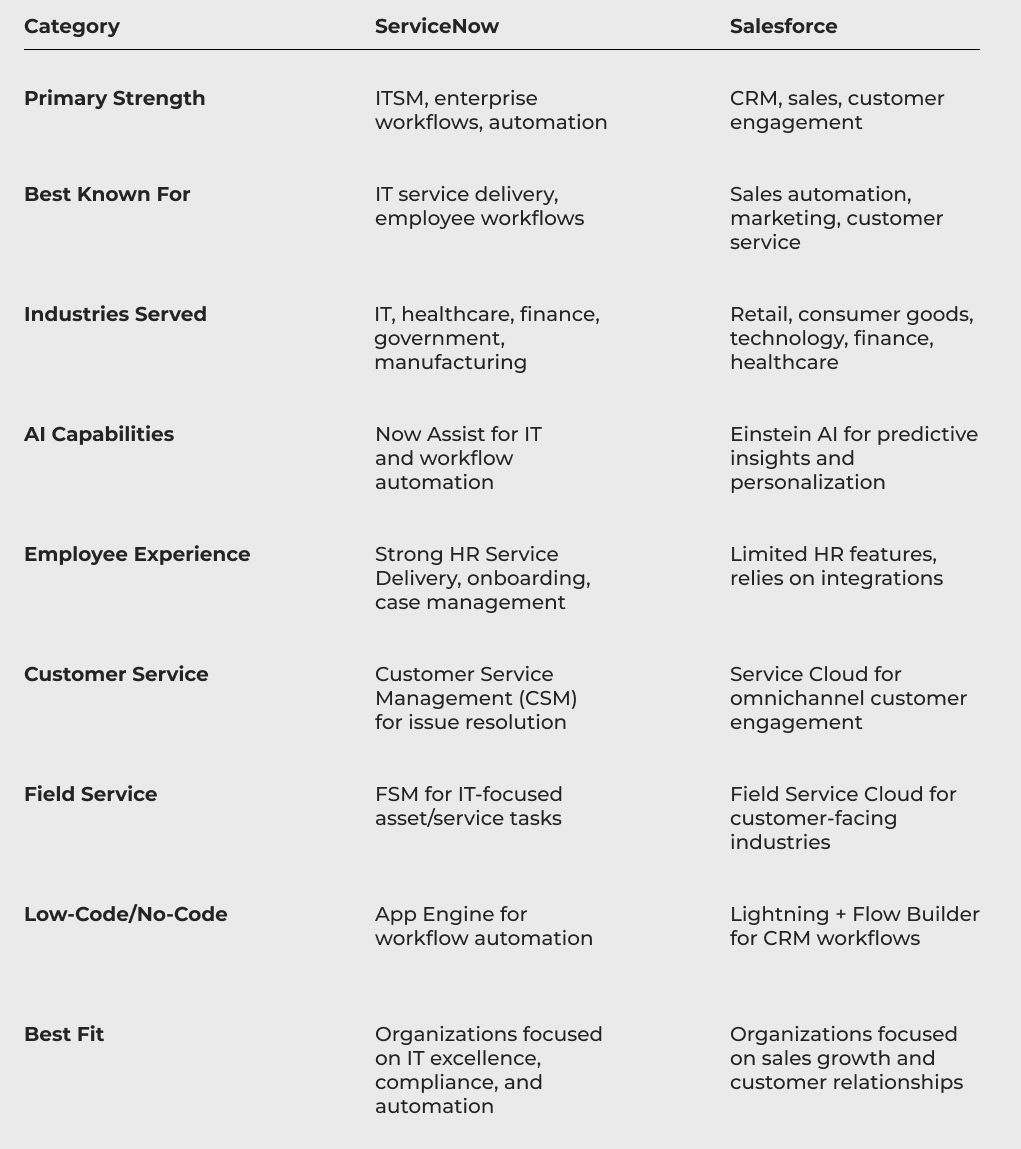
Comparing ServiceNow and Salesforce
Although ServiceNow and Salesforce target different primary business needs, the lines between them are blurring. ServiceNow has entered the CRM space with Customer Service Management (CSM), and Salesforce has introduced service management features in its Service Cloud.
IT Service Management (ITSM)
ServiceNow is widely recognized as the gold standard for ITSM. Its modules for incident, problem, change, and asset management are mature and deeply integrated. It enables IT teams to deliver proactive support, monitor systems, and automate repetitive tasks with AI-driven workflows. Salesforce, on the other hand, offers only basic IT support features within its Service Cloud. For organizations with complex IT ecosystems, ServiceNow is the clear winner.
Customer Relationship Management (CRM)
This is where Salesforce shines. With decades of expertise in CRM, Salesforce provides deep capabilities in sales automation, customer analytics, lead management, and AI-powered personalization. Its Service Cloud goes beyond simple ticketing to offer omnichannel engagement across email, chat, phone, and social media. ServiceNow’s CRM functionality, while growing, is primarily geared toward resolving service-related issues rather than managing the full sales cycle.
Field Service Management
Both platforms have field service offerings, but they serve different needs. ServiceNow FSM is designed for IT-centric industries, enabling businesses to schedule technicians, manage assets, and resolve infrastructure issues. Salesforce Field Service Cloud, on the other hand, is tailored to customer-facing industries like utilities, telecom, and retail, where technicians interact directly with customers.
Employee Experience and HR
ServiceNow excels in HR Service Delivery (HRSD). From onboarding new hires to managing employee requests and cases, ServiceNow provides a unified system to improve employee experience. Salesforce does not offer a comprehensive HR solution and instead relies on integrations with external HR platforms.
Sales and Order Management
Salesforce has a significant edge in this area. Its Sales Cloud provides everything from lead and opportunity management to forecasting and configure–price–quote (CPQ). ServiceNow does not compete here, as sales automation is not its core strength.
AI and Automation
Both platforms have made major investments in AI. ServiceNow’s Now Assist uses generative AI to improve IT workflows, suggest resolutions, and reduce manual effort. Salesforce’s Einstein AI focuses on predictive lead scoring, customer insights, and personalized recommendations. The key difference lies in their focus—ServiceNow uses AI to improve service workflows, while Salesforce uses AI to drive sales and customer engagement.
Platform and Architecture
ServiceNow’s unified architecture ensures that all modules—from IT to HR to customer service—work seamlessly together, reducing silos. Salesforce, however, thrives on its modular ecosystem. Businesses can pick and choose the clouds they need, expand through AppExchange apps, and customize workflows using Salesforce Lightning and Flow Builder.
Use Case Examples
To better understand how these platforms deliver value, let’s look at real-world scenarios:
- Healthcare with ServiceNow:
A hospital uses ServiceNow to manage IT tickets, automate compliance reporting, and streamline employee onboarding. IT teams resolve incidents faster, HR ensures smooth employee experiences, and compliance workflows keep the organization audit-ready—all within a single platform. - Retail with Salesforce:
A retail chain leverages Salesforce to unify customer data across physical stores and e-commerce platforms. Using Marketing Cloud, it delivers personalized promotions, while Service Cloud enables seamless support across phone, chat, and social media. The result: increased customer loyalty and higher sales conversion. - Manufacturing with Both:
A global manufacturing company uses ServiceNow to optimize IT operations and automate risk management, while Salesforce manages customer relationships, distributor sales pipelines, and after-sales service. Integration between the two ensures IT teams and sales teams are aligned.
When Should You Choose ServiceNow?
ServiceNow is best suited for organizations that:
- Require world-class ITSM to manage complex IT operations.
- Want to unify internal workflows across IT, HR, risk, and compliance.
- Place a high priority on automation, service delivery, and employee experience.
- Operate in industries like healthcare, finance, or manufacturing, where compliance and governance are critical.
When Should You Choose Salesforce?
Salesforce is the right choice if your business:
- Relies heavily on sales and marketing for growth.
- Needs a powerful CRM platform to manage customer data and interactions.
- Wants to deliver personalized customer experiences across multiple channels.
- Operates in industries like retail, consumer goods, or technology where customer engagement is the key differentiator.
Business Value of ServiceNow
One of the strongest reasons organisations choose ServiceNow is the tangible business value it delivers:
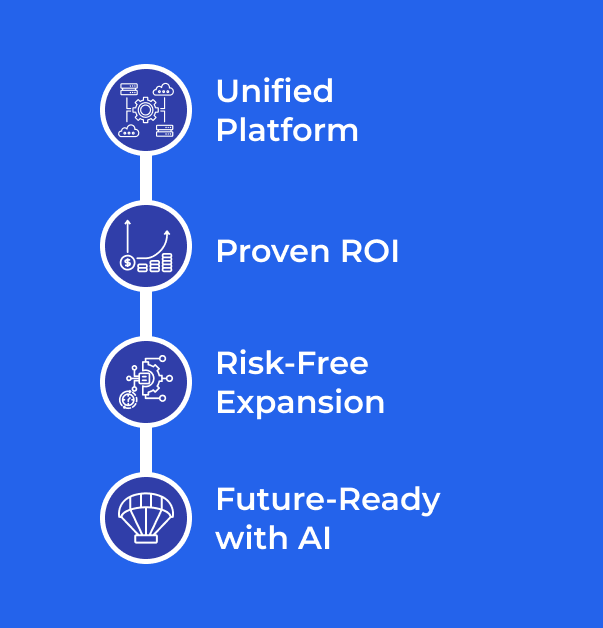
- Unified Platform – ServiceNow consolidates multiple business functions into a single data model, reducing silos and enabling holistic management.
- Proven ROI – By streamlining IT and service delivery, ServiceNow helps reduce downtime, cut operational costs, and improve employee productivity.
- Risk-Free Expansion – ServiceNow allows organizations to start with ITSM and expand into HR, risk, or customer service without disrupting existing workflows.
- Future-Ready with AI – With Now Assist and automation tools, ServiceNow positions enterprises to adopt generative AI and predictive analytics for long-term competitiveness.
Can ServiceNow and Salesforce Work Together?
Absolutely. Many enterprises find that the most effective approach is to integrate both platforms. In such setups:
- ServiceNow manages IT operations, HR workflows, and service delivery.
- Salesforce handles customer-facing functions like sales, marketing, and support.
- Integration bridges the gap, allowing IT and business teams to collaborate more effectively and giving organizations a 360° view of both customers and operations.
This hybrid strategy often delivers the best of both worlds, especially for large enterprises with diverse needs.
Final Verdict
Choosing between ServiceNow and Salesforce depends entirely on your business priorities:
- If your goal is IT excellence, streamlined internal operations, and enterprise-wide workflow automation, ServiceNow is the clear winner.
- If your focus is on sales growth, customer engagement, and personalized marketing, Salesforce stands out as the best choice.
- For organizations with complex requirements spanning IT and customer operations, integrating both platformscan deliver unmatched value.
Both platforms are global leaders, and neither is a “one-size-fits-all” solution. The right choice should align with your strategic goals, industry requirements, and digital transformation roadmap.
Frequently Asked Questions (FAQs) on ServiceNow vs Salesforce
Q1. What is the main difference between ServiceNow and Salesforce?
ServiceNow is primarily focused on IT service management (ITSM), workflow automation, and enterprise operations, while Salesforce is designed for customer relationship management (CRM), sales, and customer engagement. ServiceNow streamlines internal processes, whereas Salesforce drives customer-facing growth.
Q2. Which is better: ServiceNow or Salesforce?
The better choice depends on your business needs. If you need IT excellence, compliance, and enterprise-wide workflow automation, ServiceNow is ideal. If your goal is sales growth, customer engagement, and marketing automation, Salesforce is the better fit. Many enterprises integrate both for maximum value.
Q3. Can ServiceNow replace Salesforce?
Not entirely. ServiceNow has customer service capabilities, but it is not designed as a full CRM system. Salesforce remains the leader in sales automation, marketing, and customer lifecycle management. Organizations that rely heavily on customer-facing operations should not replace Salesforce with ServiceNow.
Q4. Can Salesforce replace ServiceNow?
No, Salesforce cannot fully replace ServiceNow for IT operations. While Salesforce offers customer service tools, it lacks the robust ITSM, HR workflows, and risk/compliance management that ServiceNow provides. Companies with complex IT infrastructures still prefer ServiceNow.
Q5. Do ServiceNow and Salesforce integrate with each other?
Yes. ServiceNow and Salesforce can be integrated to provide a 360-degree view of both IT operations and customer interactions. Many enterprises use ServiceNow for IT and HR workflows while using Salesforce for CRM and sales, creating a seamless ecosystem.
Q6. Is ServiceNow a CRM tool like Salesforce?
ServiceNow offers Customer Service Management (CSM), but it is not a full CRM like Salesforce. Its CSM is focused on issue resolution and service workflows, whereas Salesforce provides end-to-end CRM functionalities for sales, marketing, and customer engagement.
Q7. Which industries use ServiceNow and Salesforce the most?
-
ServiceNow is popular in industries like healthcare, finance, government, and manufacturing, where ITSM, compliance, and automation are critical.
-
Salesforce is widely used in retail, consumer goods, technology, and e-commerce, where customer engagement and sales growth are top priorities.
Q8. What are the AI capabilities of ServiceNow vs Salesforce?
-
ServiceNow Now Assist uses AI for workflow automation, IT ticket resolution, and predictive operations.
-
Salesforce Einstein AI provides predictive analytics, lead scoring, and personalized customer insights.
Both enhance productivity, but their focus areas differ: ServiceNow for IT workflows, Salesforce for customer engagement.
Q9. Should a business use both ServiceNow and Salesforce?
Yes, many large enterprises use both. ServiceNow optimizes internal operations, ITSM, and employee experience, while Salesforce manages sales pipelines, customer data, and marketing campaigns. Together, they deliver a complete digital transformation solution.
Q10. Which platform provides better ROI: ServiceNow or Salesforce?
Both platforms deliver strong ROI depending on use case:
-
ServiceNow ROI comes from reduced downtime, improved employee productivity, and lower IT costs.
-
Salesforce ROI comes from higher sales conversions, improved customer retention, and personalized marketing.
The right ROI depends on whether your priority is internal efficiency or customer growth.
Contact Now!
📞 Mob: +91-9911432288
📧 Email: info@appther.com
I hope this article on Salesforce vs ServiceNow has helped you gain clarity on their differences, strengths, and which platform might be the right fit for your business.
Thank you once again for reading till the end!
If you still have any queries regarding choosing between Salesforce and ServiceNow—or need expert guidance on implementation for your business—feel free to reach out to Appther Mobility Technology Pvt. Ltd. for a 100% free consultation.
Or
💬 Comment below with your questions, and we’ll be happy to answer them at the earliest.
Have a great time ahead!