Introduction
Today, customers expect instant, personalized, and always-available support. Traditional call centers often struggle to meet these demands. This is where AI voice agents come in.
An AI voice agent is more than a chatbot. It’s a smart system that can understand speech, analyze intent, respond contextually, and perform tasks like scheduling appointments or processing transactions.
At Appther Mobility Technologies, we help businesses leverage AI and conversational tech to enhance customer engagement, cut costs, and scale operations. In this article, we’ll explore AI voice agents, their benefits, use cases, tech stack, development steps, costs, and future trends by 2025.
What is an AI Voice Agent?
An AI voice agent is a virtual assistant powered by AI, NLP (Natural Language Processing), and speech recognition. Unlike traditional IVR (Interactive Voice Response) systems, AI voice agents can understand context, intent, and emotions, allowing for natural conversations.
For example, instead of pressing “1” for a bank balance, a customer can say:
“Can you tell me my account balance?”
The AI agent understands the request, checks the user’s identity, fetches account details, and responds instantly.
This shift from menu-driven to conversation-driven interactions is transforming customer service across industries.
Why Businesses Need AI Voice Agents in 2026
AI voice agents offer many benefits that enhance both business efficiency and customer experience.
- 24/7 Availability: AI voice agents can handle queries at any time.
- Cost Optimization: Automating repetitive calls saves on staffing costs and boosts efficiency.
- Scalability: AI voice systems can manage thousands of calls simultaneously, making them ideal for global enterprises.
- Personalization: Voice agents can use data from CRMs to provide customized responses, creating a human-like experience.
- Multilingual Support: Built-in translation allows businesses to reach wider audiences.
- Improved Customer Satisfaction: Quick, accurate responses lead to higher CSAT scores and brand loyalty.
Top Use Cases of AI Voice Agents Across Industries
AI voice agents are transforming how businesses operate, offering efficiency, personalization, and 24/7 availability. Here are the top industries leveraging them:
| Industry | AI Voice Agent Use Cases |
| Healthcare 🏥 | Appointment scheduling, medication reminders, teleconsultation support, insurance FAQs |
| Banking & Finance 💳 | Account inquiries, fraud alerts, loan/credit card applications, financial literacy guidance |
| E-commerce & Retail 🛒 | Order tracking, personalized product recommendations, returns/exchanges, payment/shipping FAQs |
| Travel & Hospitality ✈️ | Flight/hotel bookings, check-in/out, multilingual tourist support, real-time updates |
| Telecom 📞 | Plan activations, bill payments, troubleshooting guidance, upselling services |
| Restaurants & Food 🍴 | Table reservations, voice ordering for delivery/pickup, menu suggestions, feedback collection |
| Logistics & Supply Chain🚚 | Shipment tracking, driver navigation support, inventory management, customer delivery updates |
| Education & E-Learning🎓 | Student support, admissions assistance, learning recommendations, exam reminders |
| Real Estate 🏠 | Property inquiries, site visit scheduling, loan/EMI guidance, virtual tours |
| HR & Recruitment 👩💼 | Candidate screening, interview scheduling, employee onboarding, policy/benefits queries |
These industries use voice AI to reduce wait times, boost engagement, and free human agents for high-value tasks.
Technology Stack Required for AI Voice Agent Development
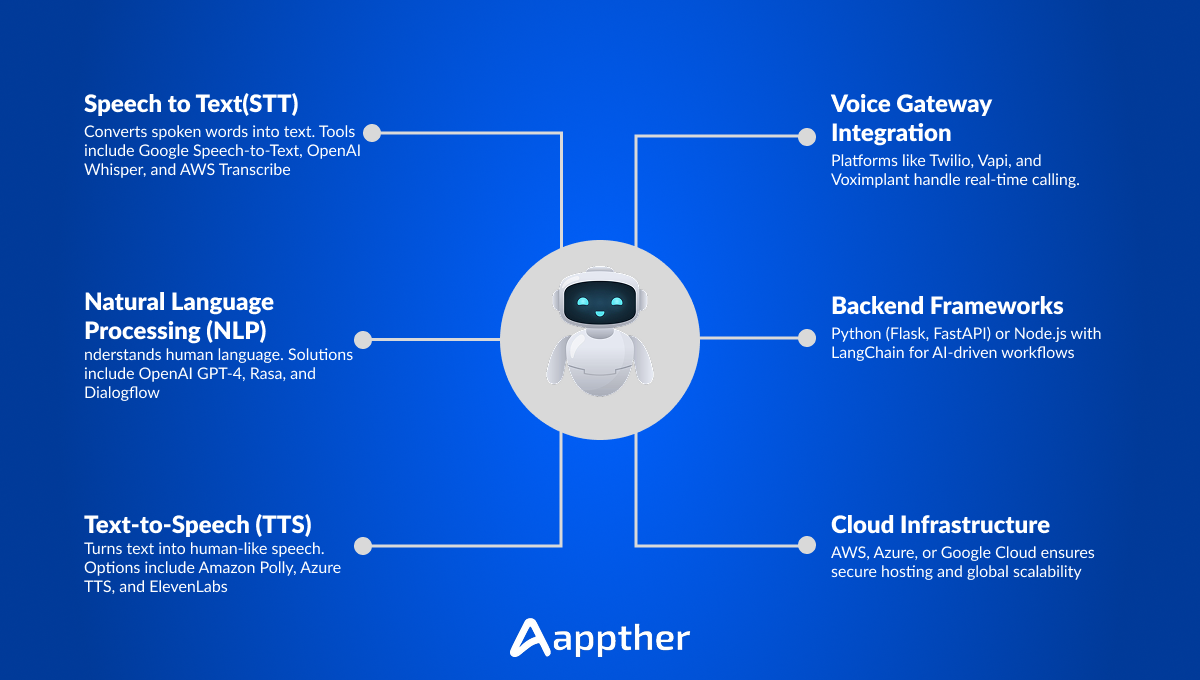
Building an AI voice agent needs a strong tech stack for speed, accuracy, and scalability:
- Speech-to-Text (STT): Converts spoken words into text. Tools include Google Speech-to-Text, OpenAI Whisper, and AWS Transcribe.
- Natural Language Processing (NLP): Understands human language. Solutions include OpenAI GPT-4, Rasa, and Dialogflow.
- Text-to-Speech (TTS): Turns text into human-like speech. Options include Amazon Polly, Azure TTS, and ElevenLabs.
- Voice Gateway Integration: Platforms like Twilio, Vapi, and Voximplant handle real-time calling.
- Backend Frameworks: Python (Flask, FastAPI) or Node.js with LangChain for AI-driven workflows.
- Cloud Infrastructure: AWS, Azure, or Google Cloud ensures secure hosting and global scalability.
Steps to Build an AI Voice Agent
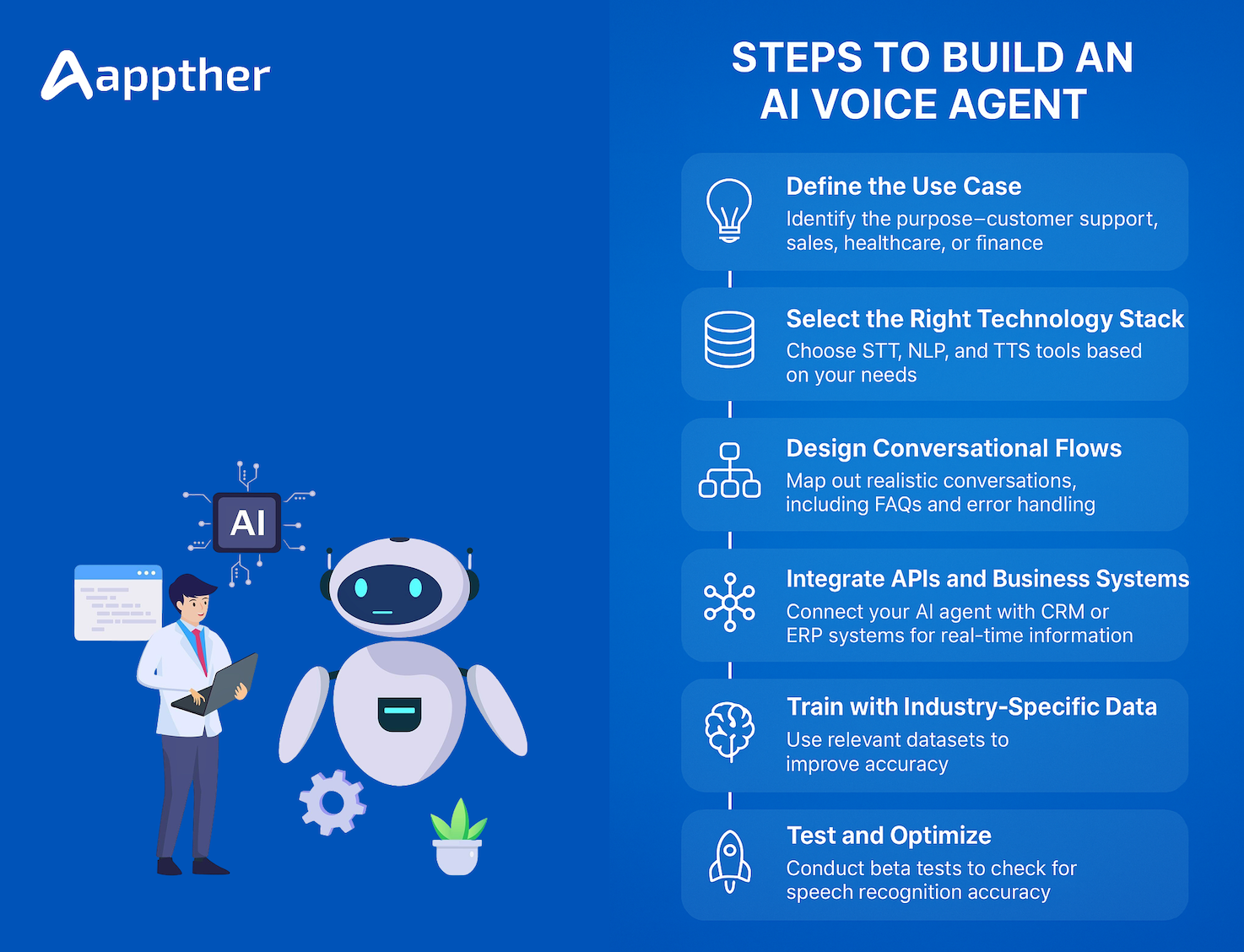
- Define the Use Case: Identify the purpose—customer support, sales, healthcare, or finance.
- Select the Right Technology Stack: Choose STT, NLP, and TTS tools based on your needs.
- Design Conversational Flows: Map out realistic conversations, including FAQs and error handling.
- Integrate APIs and Business Systems: Connect your AI agent with CRM or ERP systems for real-time information.
- Train with Industry-Specific Data: Use relevant datasets to improve accuracy.
- Test and Optimize: Conduct beta tests to check for speech recognition accuracy.
- Deploy and Scale: Launch the agent and gradually add advanced features like sentiment analysis.
Challenges in Building AI Voice Agents
While powerful, AI voice agents face challenges:
- Accents and Dialects: Speech recognition must adapt to various accents.
- Background Noise: Noisy environments complicate accurate recognition.
- Integration Issues: Legacy systems can hinder deployment.
- Data Privacy & Compliance: Sectors like healthcare must adhere to HIPAA, GDPR, and PCI DSS regulations.
At Appther, we tackle these challenges by training custom datasets, ensuring data encryption, and designing scalable architectures.
How Much Does it Cost to Build an AI Voice Agent in 2026?
The cost of developing an AI voice assistant varies based on complexity:
- Basic Voice Agent (handles FAQs): $4,000 – $10,000
- Mid-Level Agent (integrated with CRMs): $8,000 – $20,000
- Enterprise-Grade Agent (multilingual and scalable): $40,000+
Other cost factors include:
- Type of AI model (open-source vs. enterprise)
- Cloud infrastructure & hosting needs
- Ongoing maintenance and support
The Future of AI Voice Agents in 2026 and Beyond
The next generation of voice AI is moving towards empathetic, human-like interactions. With Generative AI, real-time translation, and emotion detection, AI agents will soon:
- Detect customer emotions and respond empathetically.
- Provide instant multilingual support across global markets.
- Function as digital employees, managing complex workflows.
Businesses that adopt AI voice agents now will enjoy a competitive edge, stronger customer loyalty, and lower operational costs in the future.
 https://www.appther.com/contact-us
Conclusion
AI voice agents are now a business necessity in 2025. From healthcare to banking, companies are leveraging conversational AI for faster, smarter, and more personalized customer interactions.
At Appther Mobility Technologies, we assist businesses in designing, building, and scaling AI-powered voice assistants tailored to their needs. Whether you seek cost reduction, customer satisfaction, or global reach, our expert team can make your vision a reality.
FAQs on AI Voice Agents
1. What makes AI voice agents different from chatbots or IVR systems?
Unlike chatbots or old-school IVR menus, AI voice agents can understand natural conversations, detect intent, and provide human-like responses. Instead of pressing a number or typing, customers can simply speak, and the agent responds in real time—just like talking to a real person.
2. How do businesses benefit from AI-powered voice assistants?
AI voice assistants allow businesses to serve customers round-the-clock, reduce call center expenses, and improve response times. They also scale easily during peak seasons, personalize conversations using CRM data, and support multiple languages—helping brands reach more customers with less effort.
3. Where are AI voice agents being used in 2026?
You’ll find AI voice agents everywhere—from hospitals handling patient queries to banks offering instant account details, e-commerce platforms tracking orders, and restaurants taking reservations via phone. Any industry that relies on customer interactions can use them to save time and deliver better service.
4. What technology powers AI voice assistants?
AI voice assistants are built on a combination of:
- Speech recognition tools (Google STT, Whisper, AWS Transcribe)
- NLP engines (GPT-4, Rasa, Dialogflow)
- Voice synthesis systems (Amazon Polly, Azure TTS, ElevenLabs)
- Call handling gateways (Twilio, Vapi, Voximplant)
- Backend frameworks & cloud platforms for scalability
Together, these ensure smooth, accurate, and natural interactions.
5. How much investment is required to build an AI voice agent?
The budget depends on complexity:
- Starter solutions for FAQs: around $4K–$10K
- Advanced solutions with CRM integration: $8K–$20K
- Enterprise-grade assistants with multilingual & large-scale support: $40K+
Factors like hosting, integrations, and maintenance add to the overall cost.
6. Can AI voice agents handle different languages and accents?
Yes, most modern voice AI platforms include multilingual support and translation features. While accents can sometimes challenge speech recognition, training the system with domain-specific datasets improves accuracy significantly.
7. What hurdles should businesses expect when implementing voice AI?
Common hurdles include:
- Handling regional accents or noisy environments
- Connecting with legacy systems and CRMs
- Ensuring compliance with data protection laws like GDPR or HIPAA
- Ongoing fine-tuning to keep the agent accurate and relevant
The good news: these challenges can be overcome with the right design and training strategy.
8. What does the future hold for AI voice agents?
By 2025 and beyond, voice AI will evolve into empathetic, emotionally aware assistants. Expect real-time translation across languages, advanced personalization, and digital employees capable of managing complex workflows without human support.
9. Why should a company partner with Appther Mobility Technologies for voice AI?
Our team at Appther Mobility Technologies builds AI voice assistants that are not only technically robust but also business-ready. From strategy and design to integration and scaling, we deliver tailored solutions that help companies reduce costs, improve satisfaction scores, and future-proof customer service.
Contact Now!
📞 Mob: +91-9911432288
📧 Email: info@appther.com
I hope this article on AI Voice Agent Development has helped you gain clarity on their differences, strengths, and which platform might be the right fit for your business.
Thank you once again for reading till the end!
If you still have any queries regarding choosing between Salesforce and ServiceNow or need expert guidance on implementation for your business feel free to reach out to Appther Mobility Technology Pvt. Ltd. for a 100% free consultation.