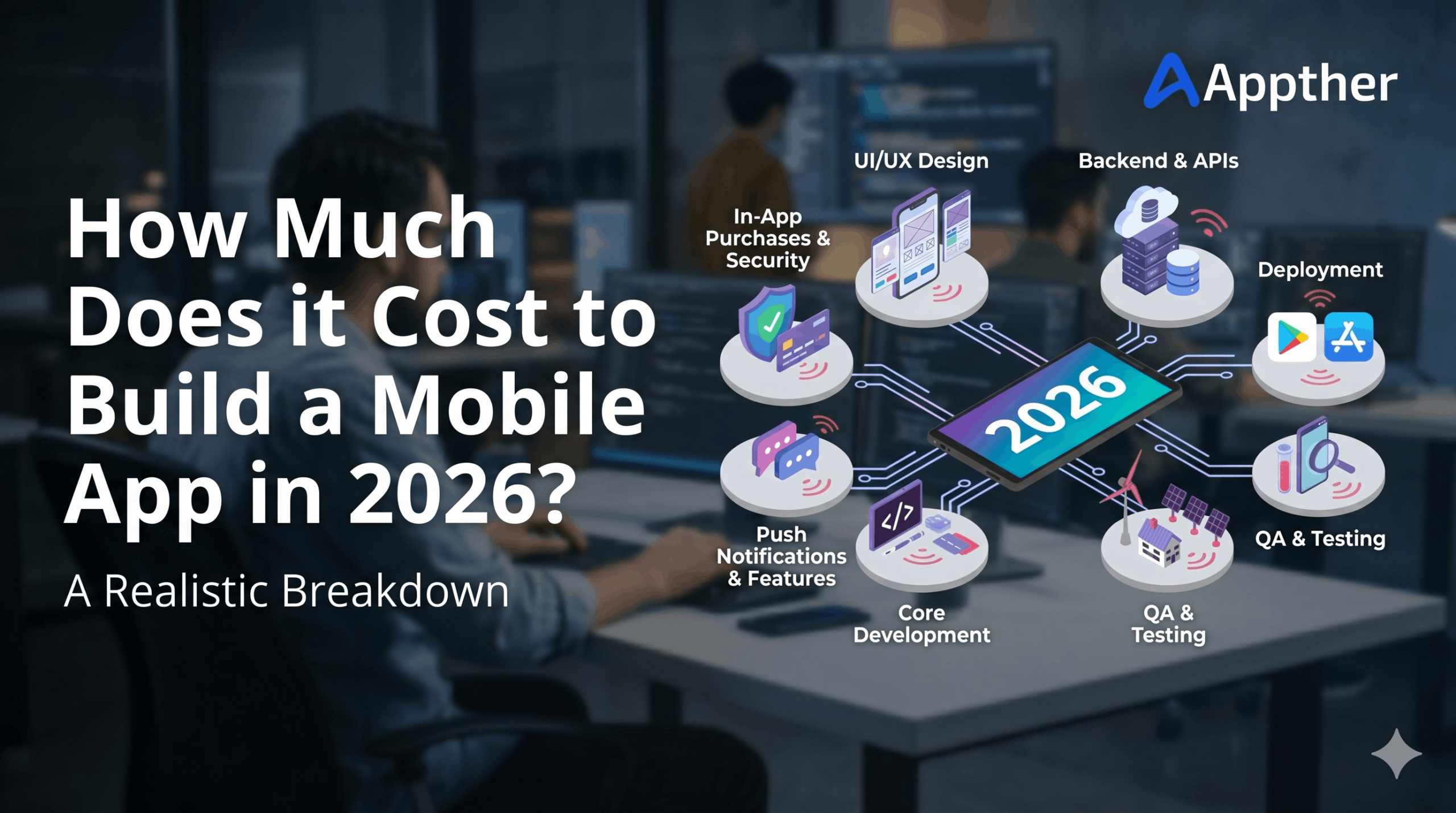
“How much does it actually cost to build a mobile app?” It is the first question every founder, product manager, and enterprise decision-maker asks and in 2026, the answer is more nuanced than ever.
The global mobile app market is projected to generate over USD 638 billion in revenue by 2027. AI features are now expected rather than optional. Cross-platform frameworks like Flutter and React Native have matured to near-native performance. Remote-first global teams have reshaped pricing. And new cost-recovery mechanisms like Australia’s R&D Tax Incentive mean that the effective cost of building an app can be significantly lower than the sticker price.
In this guide, we break down exactly what drives mobile app development costs in 2026, with realistic pricing data benchmarked against real project costs, so you can plan your budget with confidence rather than guesswork.
The Quick Answer: What Does a Mobile App Cost in 2026?
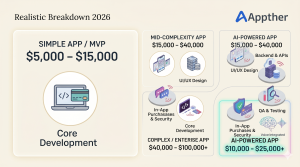
| App Type | Estimated Cost Range (USD) |
| Simple App / MVP | $5,000 – $15,000 |
| Mid-Complexity App | $15,000 – $40,000 |
| Complex / Enterprise App | $40,000 – $100,000+ |
| AI-Powered App (LLM, Voice, Vision) | $10,000 – $25,000+ |
These ranges reflect professional development in 2026 including UX/UI design, backend, QA, and project management and vary based on team location, tech stack, feature scope, and platform choice. Let us break each factor down.
Factor 1: App Complexity and Feature Set
Complexity is the single biggest driver of mobile app development cost. Every feature adds development hours, testing time, and ongoing maintenance. Here is how projects typically break down by tier.
Simple apps include 3–6 screens, basic user authentication, static content, and minimal backend logic. Examples: a restaurant menu app, a simple booking tool, or an informational business app. These typically require 400–800 development hours.
Mid-complexity apps include user accounts, real-time data synchronisation, payment integration, push notifications, maps, social features, and API connections. Examples: a fitness tracker, an e-commerce app, or a service marketplace. These require 800–1,500 development hours.
Complex and enterprise apps involve custom workflows, third-party integrations (CRMs, ERPs, payment gateways), role-based access control, advanced analytics dashboards, offline functionality, and regulatory compliance. Examples: a field service management app, a healthcare platform, or a logistics tracking system. These require 1,500–3,000+ development hours.
Appther’s mobile app development team has delivered 350+ products across all complexity tiers for clients in the USA, Australia, UAE, Canada, and across Southeast Asia.
Factor 2: Platform — iOS, Android, or Cross-Platform?
Historically, building for both iOS and Android meant nearly doubling the development cost. In 2026, that calculation has changed dramatically.
Flutter and React Native the two dominant cross-platform frameworks now deliver near-native performance on both platforms from a single codebase. Most mid-complexity apps can be built cross-platform with a 20–30 percent cost premium over a single platform, instead of the 80–100 percent premium of building two separate native apps. Industry data suggests cross-platform development reduces total cost by 30–40 percent compared to building two native applications.
When to choose native: If your app heavily leverages platform-specific APIs (like ARKit on iOS or advanced camera hardware on Android), requires bleeding-edge OS features on launch day, or demands maximum performance for real-time video processing or gaming, native development in Swift (iOS) or Kotlin (Android) is still the right choice.
For most businesses in 2026: Cross-platform with Flutter or React Native is the optimal balance of speed-to-market, development cost, and long-term maintainability.
Factor 3: Design Quality and UX Investment
Design is consistently underestimated in app budgets, yet it directly impacts retention, conversion rates, and App Store ratings. A polished, intuitive UI/UX is not a cosmetic upgrade, it is a business-critical investment.
Basic UI (template-based, minimal customisation): $2,000 – $6,000. Suitable for internal tools or proof-of-concept MVPs where user experience is secondary to functionality validation.
Custom UI/UX (wireframes, prototypes, brand-consistent design): $6,000 – $25,000. The standard for any consumer-facing app. Includes user research, wireframing, interactive prototypes, and design system creation.
Premium design (micro-interactions, animations, motion design): $20,000 – $50,000+. For brands where the app experience is a core differentiator fintech, healthcare, and lifestyle apps where trust and delight drive engagement.
Investing in design upfront almost always pays for itself through lower churn, better reviews, and higher user lifetime value.
Factor 4: Backend and Infrastructure
Nearly every app needs a backend a server environment that stores data, handles authentication, runs business logic, and connects to external services. The backend choice directly impacts both upfront cost and long-term scalability.
Managed backend (Firebase, Supabase): $3,000 – $10,000. Fastest and most cost-effective for MVPs and simple apps. Handles authentication, database, and hosting out of the box. Limited customisation for complex business logic.
Custom REST or GraphQL API: $10,000 – $40,000+. More flexible architecture suitable for apps that need custom business logic, complex data relationships, or integration with multiple third-party services.
Enterprise-grade backend (microservices architecture): $40,000 – $120,000+. Required for apps needing high availability, horizontal scaling, compliance with healthcare or financial regulations, and multi-region deployment.
Monthly cloud hosting costs on AWS, Google Cloud, or Azure typically range from $50–$500 per month for small apps, scaling to $500–$5,000+ per month for enterprise-scale applications with significant user bases.
Factor 5: Team Location and Engagement Model
Where your development team is based has a dramatic impact on total project cost. The same app built by a US agency versus an India-based firm can differ by 60–70 percent in total cost, with comparable or better quality from experienced offshore teams.
| Region | Hourly Rate (2026 USD) |
| USA / Canada | $100 – $200/hr |
| Australia | $90 – $180/hr |
| Western Europe | $80 – $150/hr |
| Eastern Europe | $40 – $80/hr |
| India / Southeast Asia | $20 – $60/hr |
India-based development firms like Appther offer a compelling value proposition: senior-level engineering talent with 350+ delivered products and global delivery experience, at a fraction of Western agency rates. The hybrid model — where product strategy and architecture are led by senior consultants while engineering execution happens with a dedicated offshore team — is what most mid-market and enterprise clients land on after evaluating all options.
Fixed-price engagement: Best for well-defined MVPs with clear scope. Predictable budget, structured milestones.
Time and material: Best for evolving products where requirements may shift. Pay for actual hours, maximum flexibility.
Dedicated team: Best for long-term products. A full team works exclusively on your app, embedded in your workflow.
Factor 6: AI Feature Costs — The Fastest-Growing Budget Line
In 2026, AI is no longer a premium add-on it is a baseline expectation for many app categories. But AI features introduce cost layers that did not exist three years ago. Understanding these is critical for accurate budgeting.
LLM-powered chatbots and copilots: $15,000 – $60,000 for development, plus $0.01 – $0.10+ per API call in production (GPT-4, Claude, or custom models). Fine-tuning a model on your domain data adds $5,000–$20,000.
AI voice agents: $25,000 – $80,000 for development including speech-to-text, LLM inference, and text-to-speech pipeline integration. Production costs of $0.07–$0.15 per minute of conversation.
Recommendation engines: $20,000 – $50,000 for a collaborative filtering or content-based system integrated with your product catalogue or content library.
Computer vision (image/video analysis): $30,000 – $80,000+ depending on whether you use pre-trained models, fine-tune existing models, or train custom models on proprietary datasets.
RAG (Retrieval-Augmented Generation) systems: $15,000 – $40,000 for building the vector database, embedding pipeline, and retrieval-augmented response layer that grounds AI responses in your business data.
Appther’s AI development services cover the full spectrum from LLM chatbot integration to custom computer vision models and voice AI agents.
Factor 7: Hidden Costs Most Businesses Miss
The quoted development cost is never the complete picture. Businesses that budget only for the build frequently face budget overruns from costs they did not anticipate. Here are the most commonly missed line items.
QA and testing: Typically 15–25 percent of total development cost. Includes manual testing, automated test suite creation, device compatibility testing, and performance testing. Skipping this leads to costly post-launch bug fixes.
Project management overhead: 5–10 percent of total cost. Covers sprint planning, daily standups, stakeholder communication, and delivery coordination. Essential for on-time, on-budget delivery.
Security audits and compliance: $1,000 – $10,000 annually depending on industry. Healthcare apps require HIPAA compliance. Financial apps need PCI DSS. Australian businesses must comply with the Privacy Act. European users trigger GDPR obligations.
Third-party API scaling costs: Payment gateways (Stripe: 2.9% + $0.30 per transaction), maps APIs (Google Maps: $7 per 1,000 loads after free tier), push notification services, SMS/OTP verification, and analytics platforms all scale with usage.
App Store rejection and rework: Apple’s review process rejects approximately 40 percent of first submissions. Budget 1–2 weeks and $2,000–$5,000 for compliance fixes and resubmissions.
Change orders during development: Scope changes after development begins typically cost 20–50 percent more than if included in the original specification. A clear PRD (Product Requirements Document) upfront minimises this risk.
Real-World Cost Examples in 2026
Example 1: Restaurant Ordering App (MVP)
Cross-platform (Flutter), menu browsing, cart, online payment via Stripe, order tracking, push notifications. Estimated cost: $22,000 – $38,000. Timeline: 8–10 weeks.
Example 2: Healthcare Appointment and Telehealth App
Patient and doctor portals, video consultations, EHR integration, HIPAA-compliant data handling, appointment scheduling, and push notifications. Estimated cost: $70,000 – $140,000. Timeline: 14–20 weeks.
Explore Appther’s healthcare industry solutions for compliant, scalable medical app development.
Example 3: AI-Powered Sales CRM Mobile App
LLM-powered lead scoring, voice note transcription, Salesforce integration, analytics dashboard, and role-based access. Estimated cost: $100,000 – $220,000. Timeline: 16–24 weeks.
Example 4: On-Demand Service Marketplace
Customer app, service provider app, admin dashboard, real-time GPS tracking, in-app payments, rating and review system, and push notifications. Estimated cost: $80,000 – $170,000. Timeline: 14–22 weeks.
For Australian Businesses: Recover Up to 43.5% of Your App Development Cost
If your business is registered in Australia, you may be eligible for the Australian Government’s Research and Development Tax Incentive (R&DTI) one of the most generous innovation incentives in the world.
For companies with aggregated annual turnover under AUD 20 million (expanding to AUD 50 million under reforms announced in the May 2026 Federal Budget), the R&DTI provides a refundable tax offset of 43.5 cents for every dollar of eligible R&D expenditure. This means the government effectively pays back 43.5 percent of your qualifying app development costs either as a reduction in tax owed or as a direct cash refund.
Example: An Australian SME spends AUD 200,000 on developing a custom mobile app with genuinely novel technical components (e.g., a new recommendation algorithm, experimental data architecture, or AI model training). If the activities qualify, the company recovers AUD 87,000 through the R&DTI reducing the effective cost to AUD 113,000.
Eligible expenditure includes salaries of staff directly engaged in R&D, contractor fees for development services, materials consumed during experimentation, and infrastructure costs directly attributable to R&D activities. The key eligibility requirement is that the development must involve genuine technical uncertainty where the outcome is not known or determinable in advance.
This makes partnering with an experienced offshore development team like Appther doubly advantageous for Australian businesses: you get world-class engineering at competitive global rates, and a significant portion of the eligible spend may be recoverable through the R&DTI. Note: Overseas R&D expenditure requires a separate advance application to Innovation and Science Australia.
How to Reduce Mobile App Development Costs Without Sacrificing Quality
1. Start with an MVP. Build only the core features that validate your hypothesis. Launch, collect real user data, then iterate. Companies that adopt an MVP-first approach consistently achieve faster time-to-market and up to 40 percent cost savings compared to building the full product upfront.
2. Choose cross-platform development. Flutter or React Native for most apps reduces total cost by 30–40 percent versus building separate native apps, with near-identical user experience.
3. Leverage proven third-party services. Use Stripe for payments, Twilio for SMS and voice, Firebase for authentication, and established LLM APIs for AI features. Building these from scratch wastes weeks and adds unnecessary risk.
4. Invest in experienced teams, not cheap teams. Junior teams may quote lower upfront, but rework, architectural debt, performance issues, and delayed launches end up costing 2–3x more. Experienced teams like Appther ship faster, cleaner, and with fewer surprises.
5. Plan your roadmap in phases. Phase 1 for market validation, Phase 2 for growth features, Phase 3 for advanced functionality and AI integration. This spreads investment over time and aligns spending with revenue generation.
6. Explore tax incentives. Australian businesses should investigate the R&D Tax Incentive. US businesses may qualify for the Section 174 R&D tax deduction. These programmes can reduce effective development costs by 20–43 percent.
Ongoing Costs After Launch: What to Budget For
App development is not a one-time expense. A live app with an active user base requires ongoing investment to remain functional, secure, and competitive.
Maintenance and bug fixes: Typically 15–20 percent of initial development cost annually. Covers OS compatibility updates, bug fixes, performance optimisation, and dependency upgrades.
App Store fees: Apple Developer Program: USD 99 per year. Google Play: USD 25 one-time registration fee.
Cloud infrastructure: Monthly hosting, CDN, database, and compute costs ranging from $100–$500 per month for small apps to $1,000–$10,000+ per month for high-traffic enterprise apps.
New feature development: Ongoing roadmap work based on user feedback, market changes, and competitive dynamics. Budget as a quarterly or annual investment aligned with business goals.
Third-party API subscriptions: Maps, payments, SMS, push notifications, analytics, and AI model inference costs all of which scale with usage.
Budget at least $1,000–$3,000 per month for a live app with an active, growing user base.
Frequently Asked Questions
What is the average cost to build a mobile app in 2026?
The average cost for a mid-complexity mobile app in 2026 ranges from USD 50,000 to 120,000 when built by a professional team. Simple MVPs start from USD 15,000–50,000, while complex enterprise apps with AI features can exceed USD 300,000. The exact cost depends on feature complexity, platform choice, design quality, and team location.
Is cross-platform development cheaper than native in 2026?
Yes. Cross-platform frameworks like Flutter and React Native reduce total development cost by 30–40 percent compared to building separate native iOS and Android apps. They share a single codebase for both platforms, meaning one team can deliver to both markets simultaneously. For most business apps in 2026, cross-platform is the recommended approach.
How long does it take to build a mobile app?
A simple MVP typically takes 6–10 weeks. Mid-complexity apps take 10–16 weeks. Complex enterprise apps take 16–24+ weeks. These timelines assume a professional team using agile delivery with continuous testing. The discovery and design phase (2–4 weeks) precedes active development.
What ongoing costs should I budget for after launching an app?
Plan for maintenance and bug fixes (15–20 percent of initial cost annually), cloud hosting ($100–$5,000+ per month depending on scale), third-party API fees, App Store subscription fees, and quarterly feature updates. A realistic monthly budget for a live app ranges from $1,000 to $3,000 for small to mid-size apps.
Can Australian businesses get tax benefits for app development?
Yes. The Australian R&D Tax Incentive offers a refundable tax offset of 43.5 percent for eligible R&D expenditure by companies with aggregated turnover under AUD 20 million (expanding to AUD 50 million from July 2028). If your app development involves genuine technical uncertainty and experimentation, a significant portion of the cost may be recoverable. Consult an R&D tax specialist to assess eligibility.
Why should I choose Appther over a local development agency?
Appther combines senior-level engineering expertise (350+ products delivered across 12+ countries) with India-based pricing that is 60–70 percent lower than US or Australian agencies. Our team builds using Flutter, React Native, Swift, Kotlin, and integrates cutting-edge AI capabilities. Every engagement starts with a free consultation and detailed estimate, so you know exactly what you are investing before committing.
Final Thoughts: Build Smart, Not Cheap
Building a mobile app in 2026 is an investment but a well-built app delivers measurable ROI through new revenue streams, operational efficiency, and competitive advantage. The key is to plan realistically, start with an MVP, choose the right technology and team, and budget for the full lifecycle rather than just the initial build.
Avoid lowball quotes that cut corners and lead to painful rebuilds. Work with a team that has a proven track record, communicates transparently, and aligns with your long-term business goals.
Ready to Build Your Mobile App?
Appther has delivered 350+ mobile apps, AI solutions, and enterprise products across healthcare, fintech, logistics, and retail — for clients in the USA, Australia, UAE, Canada, and Southeast Asia. We build with Flutter, React Native, Swift, Kotlin, and integrate AI capabilities including LLM chatbots, voice agents, and AI-powered automation.
Get your free project estimate today — detailed cost breakdown within 48 hours, no commitment required.