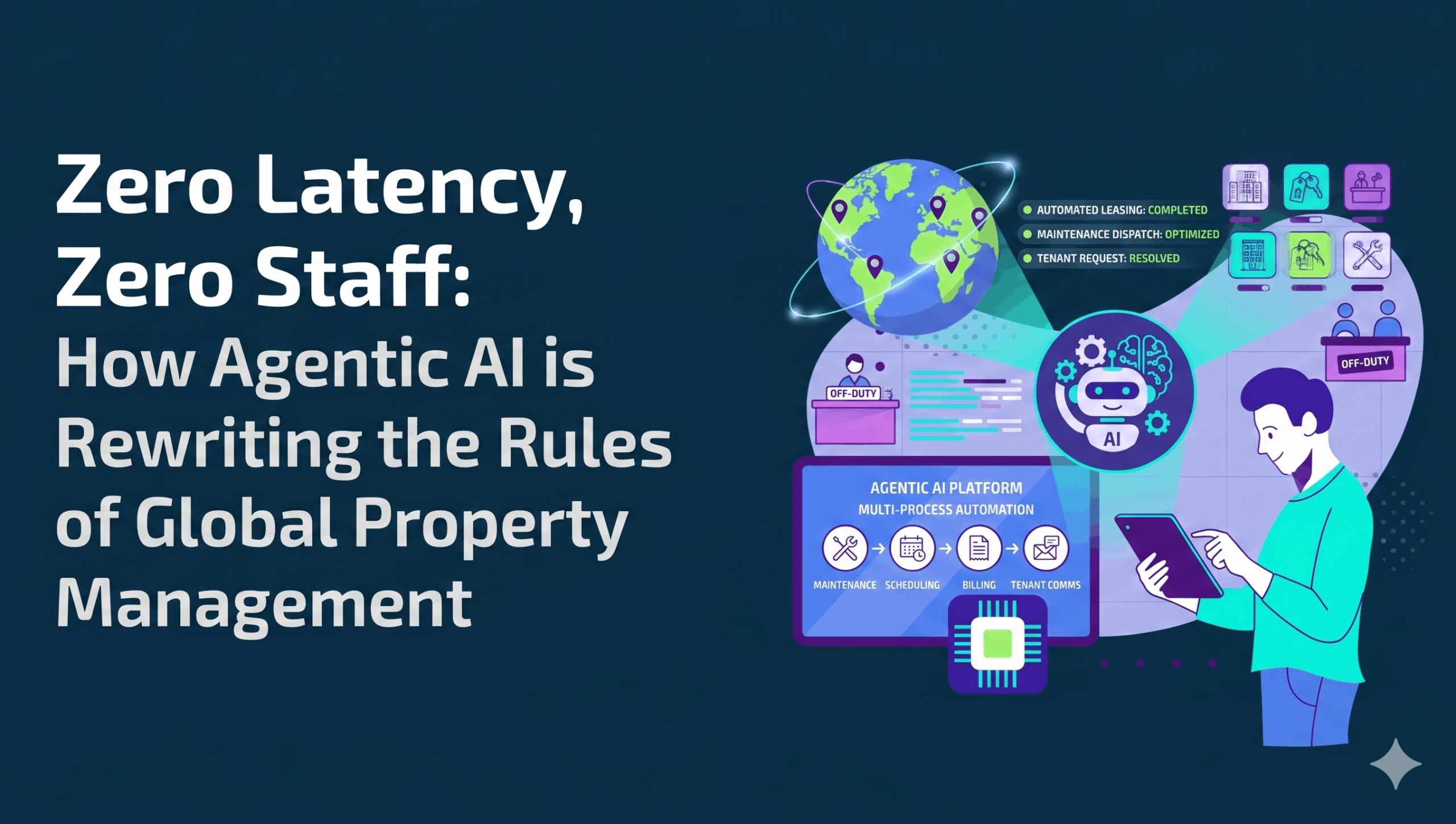
For years, the real estate industry’s relationship with Artificial Intelligence was defined by a small, flickering chat window in the corner of a website. “How can I help you?” the bot would ask before serving up little more than a glorified FAQ menu.
That era is officially over.
As we move through 2026, the global real estate market is no longer interested in AI that simply talks. With AI-enhanced real estate services now valued at over $404.9 billion, investors, developers, and property managers are deploying something far more powerful: Agentic AI autonomous systems that don’t just answer questions. They act, coordinate, and complete entire workflows without human prompting.
This shift from the “Chatbot Era” (2023–2025) to the “Agentic Era” is not incremental. It is a fundamental rewiring of how property portfolios are managed, how leads are converted, and how buildings are run. Here is why 2026 is the definitive tipping point and what it means for your business.
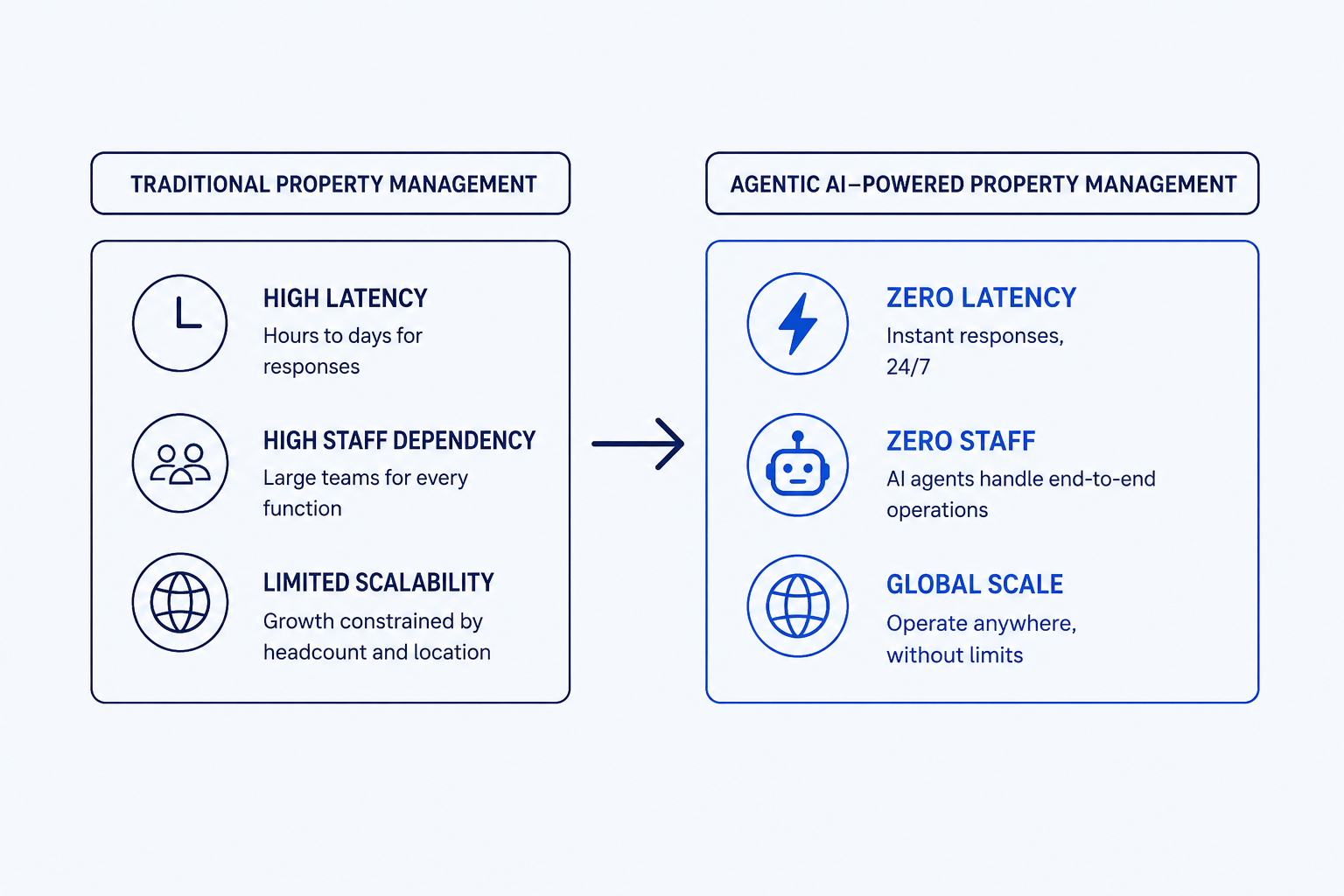
1. From conversation to completion: what is Agentic AI?
To understand the shift, it helps to contrast the two systems side by side.
The chatbot (2024 model)
A prospective tenant asks about scheduling a viewing. The chatbot provides a link to a calendar. The human still clicks, selects a time, and confirms. The AI has done nothing more than redirect.
The AI agent (2026 model)
The same enquiry triggers a multi-step autonomous workflow. The agent verifies the lead’s credit profile via API, checks the property manager’s real-time calendar, cross-references local traffic patterns to avoid clashes, books the viewing, and sends a one-time digital key to the prospect’s phone all before the broker has read the notification.
| What makes a system “agentic”?
Agency: the ability to reason through a goal, use external software tools, and execute multi-step workflows without constant human prompting. In 2026, we have moved from “AI as a consultant” to “AI as a colleague.” |
This is not a marginal upgrade. It is a change in kind. And it is already reshaping how the most competitive firms in London, Dubai, New York, and Singapore operate.
2. The death of “speed-to-lead” anxiety
In global real estate, the “5-minute rule” has long been the gold standard: contact a lead within five minutes of enquiry, or the probability of conversion drops by 80%. Firms have hired overnight staff, built auto-responder sequences, and invested in call centres — all to close that gap.
In 2026, five minutes is too slow.
Agentic AI has enabled what the industry is calling Zero-Latency Lead Orchestration. Rather than auto-responses, these agents analyse the sentiment of an enquiry, score lead intent using behavioural data signals, and trigger personalised nurture sequences — all within seconds, all while the human broker is still asleep.
| 2026 market benchmark
Firms using Agentic AI for lead management report a 60% reduction in operational expenses and a 14% increase in warm hand-offs to human agents. Across major markets, AI agents are now handling up to 70% of initial enquiries end-to-end. |
The competitive implication is stark: firms still relying on human-first lead response are operating at a structural disadvantage that compounds with every missed enquiry.
3. Multi-Agent Systems (MAS): the rise of the digital property department
The most significant technical breakthrough of 2026 is not any single AI model — it is the architecture of how multiple agents work together. Rather than one monolithic “giant brain” attempting to handle everything, leading firms are deploying specialised Digital Departments: networks of purpose-built agents that collaborate in real time.
A live MAS workflow in property management
- The Maintenance Agent continuously scans IoT sensors across a portfolio. It detects an abnormal vibration signature in a high-rise HVAC unit — before any failure occurs.
- The Procurement Agent automatically searches for the best-priced replacement part, verifies compatibility against the building’s warranty records, and drafts a purchase order for approval.
- The Communication Agent notifies affected tenants of the scheduled repair window, updates the building’s financial ledger in Yardi or AppFolio, and closes the maintenance ticket.
No human touches any of these steps until the purchase order requires sign-off. This “Orchestrator Architecture” allows global firms to scale their portfolio operations without a proportional increase in headcount — a critical advantage as portfolios grow across jurisdictions.
| Appther insight
At Appther, we design and deploy custom Multi-Agent Systems that integrate directly with Yardi, Salesforce, AppFolio, and your existing IoT infrastructure. Our agents don’t replace your property team — they remove the administrative ceiling that limits what your team can manage. |
4. The commercial pivot: REITs and asset optimisation
While residential real estate was the early adopter of AI-assisted leasing, Commercial Real Estate (CRE) and REITs are the biggest spenders on Agentic AI in 2026. The reason is scale: for a global REIT managing thousands of assets across multiple jurisdictions, the administrative overhead of manual lease abstraction, compliance monitoring, and capital planning has historically been enormous.
Where Agentic AI is creating measurable value in CRE
- Lease abstraction: Agents parse complex, multi-jurisdictional lease documents in seconds — extracting break clauses, rent escalation triggers, and compliance obligations that previously took analysts days to review.
- Dynamic pricing: Agents monitor real-time market data and flag rent escalation opportunities the moment a localised demand spike is detected — eliminating the delay between market movement and management action.
- Predictive risk modelling: AI agents continuously run scenario analyses on vacancy rates and interest rate fluctuations, enabling predictive capital allocation rather than reactive crisis management.
For fund managers and asset directors, this translates directly into improved yields and reduced exposure to preventable risk.
5. Global compliance and the “Sovereignty” imperative
As Agentic AI becomes more autonomous, regulatory frameworks have responded. The EU AI Act and Canada’s Artificial Intelligence and Data Act (AIDA) now set strict boundaries on how autonomous systems may process personal and financial data.
For global real estate firms, this creates a “Sovereignty” challenge: how do you deploy intelligent, connected AI while ensuring that tenant data never crosses a regulatory border it shouldn’t?
The answer in 2026 is Sovereign AI deployment: AI agent instances that operate entirely within a specific country’s cloud region — for example, Azure Canada Central for Canadian operations, or AWS Frankfurt for EU portfolios. The intelligence is global and consistent. The data stays local and compliant.
| Compliance note for enterprise deployments
Enterprise-grade Agentic AI uses Zero-Retention protocols: your proprietary data and tenant information are never used to train or improve external AI models. All processing occurs within your agreed data residency boundary. |
6. Case study: the “Zero-Staff” leasing office
In early 2026, a major residential developer in Singapore launched a 400-unit luxury complex with a fully AI-managed leasing front end. The project was designed as a proof-of-concept for what Agentic AI could deliver at scale, with human involvement reserved exclusively for final legal verification and premium move-in experiences.
Phase 1 — Enquiry handling
All 12,000 initial enquiries across WhatsApp, WeChat, and email were handled end-to-end by AI agents — qualification, FAQs, and appointment scheduling — with zero human involvement.
Phase 2 — Self-guided tours
Qualified prospects received automated tour confirmations and one-time smart-lock access codes. AI agents conducted virtual orientation briefings and followed up post-visit with personalised pricing proposals.
Phase 3 — Lease generation
Agents reviewed submitted financial disclosures, ran automated compliance checks, and generated final lease agreements tailored to each applicant’s profile.
Result
| 95% occupancy in 45 days
The development reached near-full occupancy in under seven weeks. Human intervention was required only for final signature verification and white-glove move-in welcomes — two touchpoints where personalisation delivered measurable tenant satisfaction. |
The case study illustrates a critical insight: Agentic AI does not eliminate the human role in real estate. It concentrates it where human presence creates genuine value.
7. The 2026 PropTech tech stack: how Agentic AI is built
For firms ready to move beyond basic chatbots, transitioning to a fully autonomous Multi-Agent System requires a coherent underlying architecture. In 2026, the industry has converged on a Three-Layer Stack.
Layer 1: the data fabric (memory)
AI agents are only as reliable as the data they can access. To prevent hallucinations — instances where an AI fabricates a lease term, property price, or compliance requirement — enterprise deployments use Retrieval-Augmented Generation (RAG).
- How it works: When a prospect asks about service charge details, the agent does not rely on its training data. It retrieves the exact figure from your live Yardi ledger or lease PDF, then generates its response from that verified source.
Layer 2: the action layer (tools)
This is where Agentic AI earns its name. Rather than merely informing users, agents use Function Calling to interact directly with your existing software stack.
- Example: A qualified lead triggers a create_tour_booking function that writes to Calendly and simultaneously sends a POST request to your Smart Lock API — generating a one-time entry code without any human action.
Layer 3: the orchestration layer (the brain)
Using frameworks such as LangChain or Microsoft AutoGen, an Orchestrator Agent manages and coordinates your network of specialist agents.
- In practice: Your Leasing Agent, Maintenance Agent, and Compliance Agent each handle their domain, communicating results to a central Manager Agent that sequences decisions and escalates to humans only when genuinely necessary.
2026 Global PropTech benchmarks
The performance gap between legacy chatbot deployments and Agentic AI systems has widened significantly. As of Q1 2026:
| Metric | Traditional chatbot | Agentic AI (2026) | Impact |
| Lead response time | 5–30 minutes | < 10 seconds | Significant |
| Task completion rate | 12% (passive) | 82% (autonomous) | Significant |
| Operational cost reduction | ~10% | 35–45% | Significant |
| Market size (AI in RE) | $301B (2025) | $404.9B (2026) | Significant |
| Back-office productivity boost | Minimal | +30% | Significant |
Source: Appther PropTech Benchmark Report, March 2026.
Conclusion: the competitive divide of 2026
We have crossed a threshold. A human-only brokerage or property management firm today cannot match the speed, accuracy, and 24/7 scalability of an agentic-enhanced competitor. Agentic AI has moved from competitive advantage to competitive necessity.
The question is no longer “Do you have a chatbot?” It is “How many agents do you have in your mesh, and what can they do while your team sleeps?”
By 2027, manual lead management will be widely regarded as a legacy liability. The gap between firms that have built agentic infrastructure and those that have not will be structural not easily closed by incremental hiring or tooling upgrades.
| Ready to build your agentic property operation?
Appther designs and deploys custom AI agent systems that integrate seamlessly with Yardi, Salesforce, AppFolio, and your IoT infrastructure. From lead orchestration to predictive maintenance, we build the digital workforce your portfolio needs to compete in 2026 and beyond. Contact us at appther.com to start your Agentic AI assessment.
|
Frequently asked questions
| Will Agentic AI replace my leasing agents and property managers?
No — it fundamentally evolves their role. By automating the speed-to-lead response, routine maintenance scheduling, and back-office documentation (which currently accounts for roughly 50% of team workload), your people are freed to focus on high-value human interactions: complex negotiations, sensitive tenant disputes, community building, and the kind of relationship management that closes deals at premium prices. |
| How does Agentic AI differ from the chatbot we already have?
A chatbot is reactive: it waits for a question and returns a pre-programmed response or a link. An AI agent is goal-oriented and autonomous. Given a task — qualify this lead, schedule this tour, procure this part — it reasons through the steps, uses your software tools, and executes the workflow from start to finish without human prompting at each step. |
| Can Agentic AI integrate with our existing Property Management Software?
Yes. Enterprise-grade Agentic AI uses an Action Layer integration that allows agents to read and write data directly into platforms like Yardi, AppFolio, and Salesforce via secure APIs. Rather than just storing data, the agent actively ‘pushes buttons’ in your software to automate administrative tasks — booking appointments, updating ledgers, generating documents. |
| Is our tenant data safe with an autonomous AI system?
Security is built on Sovereign AI principles. Enterprise-grade agents use Zero-Retention protocols: your data is never used to train external AI models. To comply with frameworks such as the EU AI Act and Canada’s AIDA, agents can be deployed on localised cloud infrastructure — ensuring strict data residency and regulatory compliance in every jurisdiction you operate in. |
| What is a Multi-Agent System and why does it matter?
A Multi-Agent System is an architecture where several specialised AI agents operate as a coordinated digital department. A Leasing Agent qualifies the prospect, a Compliance Agent verifies documentation, and a Financial Agent updates the ledger — all communicating via a Manager Agent. The result is an entire business process handled autonomously, at scale, 24 hours a day. |
| How quickly can we expect a return on investment?
Most deployments report measurable ROI within three to six months. Primary value drivers include a dramatic reduction in lead response latency, a significant drop in vacancy rates through 24/7 autonomous booking, and a 30% improvement in back-office productivity from automated lease abstraction, invoice reconciliation, and compliance monitoring. |