The rapid growth of the Internet of Things (IoT) has changed how businesses interact with physical devices, machines, vehicles, and environments. At the center of every successful IoT ecosystem lies a powerful mobile application that enables users to monitor, control, and analyze connected devices in real time.
Mobile App Development for IoT is no longer limited to simple device control. Modern IoT mobile apps support advanced analytics, automation, AI-driven insights, remote diagnostics, and enterprise-grade security. From smart homes and wearables to industrial IoT (IIoT) and connected vehicles, mobile apps act as the primary interface between users and IoT platforms.
What Is a Mobile App for IoT?
A mobile app for IoT is a software application designed to communicate with IoT-enabled devices through cloud platforms or gateways. It allows users to access real-time data, send commands to devices, configure automation rules, and gain actionable insights using smartphones or tablets.
Unlike traditional mobile apps, IoT applications must handle continuous data streams, device connectivity, scalability, and security across thousands or even millions of connected endpoints.
Core Objectives of an IoT Mobile Application
- Enable seamless communication between users and devices
- Visualize real-time and historical IoT data
- Support remote control and automation
- Ensure secure device and user authentication
- Scale efficiently as devices and users grow
Why Mobile Apps Are Critical for IoT Solutions
Mobile applications are a critical component of IoT solutions because they convert raw sensor data into meaningful user experiences.
Business Benefits of IoT Mobile Apps
- Real-time visibility: Monitor device performance anytime, anywhere
- Operational efficiency: Reduce manual intervention through automation
- Cost optimization: Predict failures and reduce downtime
- Improved customer experience: Intuitive mobile interfaces increase adoption
- Scalability: Easily manage thousands of connected devices
With advancements in 5G connectivity, edge computing, and AI, mobile apps are becoming the most efficient way to interact with complex IoT ecosystems.
Key Features of an IoT Mobile Application
A successful IoT mobile app development project depends heavily on selecting the right feature set.
1. Secure User Authentication & Role-Based Access
- Multi-factor authentication (MFA)
- Role-based access control (Admin, Operator, End User)
- Device-level permission management
2. Device Onboarding & Provisioning
- QR code or BLE-based device pairing
- Bulk device onboarding
- Secure device identity management
3. Real-Time Data Monitoring & Dashboards
- Live sensor data streaming
- Custom dashboards with charts and KPIs
- Device health and status indicators
4. Remote Device Control & Automation
- Start/stop device operations remotely
- Rule-based automation workflows
- Scheduled actions and triggers
5. Alerts, Notifications & Event Management
- Threshold-based alerts
- Fault detection notifications
- Push notifications, SMS, and email alerts
6. Data Analytics & Reporting
- Historical data visualization
- AI-powered predictive analytics
- Exportable reports for compliance and audits
7. Firmware Updates & Device Maintenance
- Over-the-air (OTA) firmware updates
- Device diagnostics and logs
- Version and rollback management
IoT Mobile App Architecture
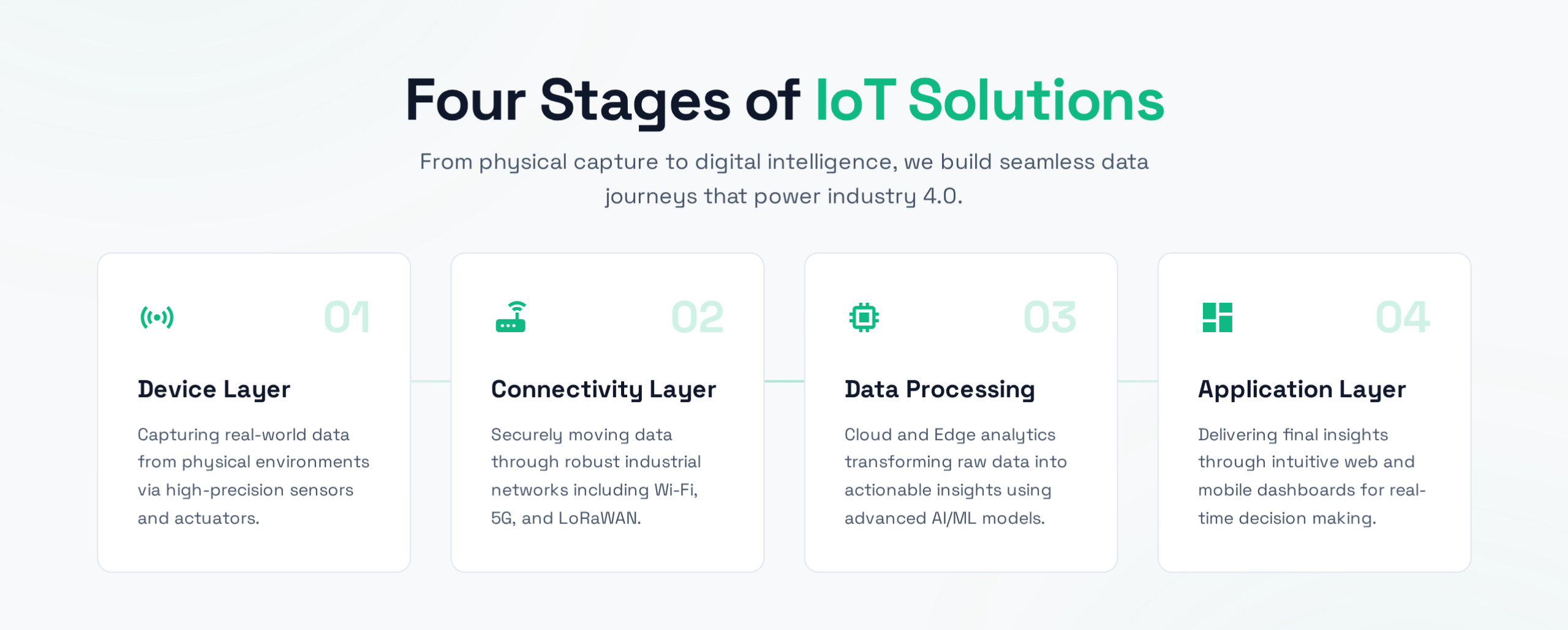
A robust IoT mobile app architecture ensures scalability, security, and high performance.
1. IoT Devices & Sensors
Physical devices equipped with sensors collect data such as temperature, location, speed, or pressure.
2. Connectivity & Communication Layer
- Wi-Fi, Bluetooth, BLE
- LTE, 4G, 5G
- LPWAN (LoRaWAN, NB-IoT)
3. IoT Gateway
Aggregates device data, performs protocol translation, and enables edge processing.
4. Cloud & IoT Platform
- Device management
- Data ingestion and processing
- Rules engine and analytics
5. Backend APIs & Microservices
Secure APIs that connect the IoT platform with the mobile application.
6. Mobile Application (Android & iOS)
User-facing interface for monitoring, control, and analytics.
Best Technology Stack for IoT Mobile App Development
Choosing the right IoT app development technology stack is crucial for long-term scalability.
Mobile Application Layer
- Android IoT App Development: Kotlin, Java
- iOS IoT App Development: Swift
- Cross-Platform: Flutter, React Native
Backend & Cloud Infrastructure
- Node.js, Python, Java
- AWS IoT Core, Azure IoT Hub, Google Cloud IoT
- RESTful & GraphQL APIs
Databases & Data Processing
- PostgreSQL, MongoDB
- Time-series databases (InfluxDB, TimescaleDB)
IoT Communication Protocols
- MQTT (lightweight and efficient)
- CoAP
- HTTP/HTTPS
- WebSockets
Security & Compliance
- TLS/SSL encryption
- OAuth 2.0, JWT
- Secure device certificates
Industry Use Cases of IoT Mobile Apps
Smart Home & Consumer IoT
IoT mobile applications play a central role in smart home ecosystems by enabling users to control and monitor connected devices from a single interface. These apps integrate with smart lighting, thermostats, door locks, CCTV cameras, and voice assistants.
Key capabilities include:
- Remote control of home devices
- Real-time security alerts and surveillance access
- Energy usage monitoring and optimization
- Automation scenarios (e.g., schedules, scenes)
This use case is widely adopted in residential and consumer IoT markets, improving convenience, safety, and energy efficiency.
Healthcare & Wearable IoT
In healthcare, IoT mobile apps connect wearable and medical devices to doctors, patients, and caregivers. These applications enable continuous health monitoring and early detection of anomalies.
Common use cases include:
- Remote patient monitoring (RPM)
- Fitness and wellness tracking
- Integration with medical-grade devices
- Alerts for abnormal vitals and medication adherence
IoT mobile apps help healthcare providers improve patient outcomes while reducing operational costs and hospital visits.
Automotive & Connected Vehicles
IoT mobile apps are a core component of connected vehicle and automotive ecosystems. They enable seamless interaction between drivers, vehicles, and backend platforms.
Typical automotive IoT app features:
- Vehicle diagnostics and health monitoring
- Real-time vehicle tracking and fleet management
- Remote locking, ignition, and climate control
- Infotainment and Android Automotive integration
These applications enhance driver experience, improve safety, and support predictive vehicle maintenance.
Industrial IoT (IIoT)
Industrial IoT mobile apps are designed to monitor and manage machinery, equipment, and production processes in real time. They are widely used in manufacturing, oil & gas, and heavy industries.
Key IIoT mobile app use cases:
- Predictive maintenance and fault detection
- Asset tracking and equipment monitoring
- Production performance dashboards
- Safety alerts and compliance monitoring
IIoT mobile apps help organizations reduce downtime, improve productivity, and optimize operational efficiency.
Retail, Logistics & Supply Chain
In retail and logistics, IoT mobile apps provide real-time visibility into inventory, shipments, and storage conditions.
Key applications include:
- Inventory and warehouse management
- Cold-chain monitoring for perishable goods
- Real-time shipment tracking
- Demand forecasting and loss prevention
These IoT applications improve supply chain transparency, reduce wastage, and enhance customer satisfaction.
Energy, Utilities & Smart Infrastructure
IoT mobile apps are increasingly used in energy and utility sectors to monitor consumption, manage infrastructure, and detect faults.
Typical use cases include:
- Smart meter monitoring
- Energy consumption analytics
- Grid and utility asset management
- Fault detection and outage alerts
Such applications support sustainability goals, reduce energy losses, and enable data-driven decision-making for utility providers.
Best Practices for Building Scalable IoT Mobile Apps
- Design cloud-native and microservices-based architecture
- Implement security at device, network, and application layers
- Optimize apps for low latency and high availability
- Support OTA updates and remote diagnostics
- Follow industry compliance standards (ISO, HIPAA, GDPR where applicable)
- Focus on intuitive UX for complex IoT workflows
Why Choose Appther for IoT Mobile App Development?
Choosing the right technology partner is critical for the success of any IoT initiative. Appther brings deep expertise in mobile, cloud, and IoT ecosystems to deliver secure, scalable, and future-ready IoT mobile applications.
1. End-to-End IoT Expertise
Appther offers complete IoT mobile app development services—from device connectivity and cloud integration to mobile app design, development, and deployment. Our team understands the entire IoT lifecycle, ensuring seamless communication between devices, platforms, and users.
2. Strong Mobile & Automotive Experience
With proven experience in Android, iOS, Android Automotive, and connected vehicle solutions, Appther builds high-performance IoT mobile apps for consumer, enterprise, and automotive use cases.
3. Scalable & Secure Architecture
We design cloud-native and microservices-based architectures that scale effortlessly as your IoT ecosystem grows. Security is embedded at every layer—device, network, backend, and mobile app—to protect sensitive data.
4. Custom-Built Solutions, Not Templates
Every IoT use case is unique. Appther develops custom IoT mobile applications tailored to your business requirements, industry standards, and user workflows—ensuring long-term flexibility and performance.
5. AI, Analytics & Automation Ready
Our IoT mobile apps are built to support advanced analytics, automation rules, and AI-driven insights, enabling predictive maintenance, smarter decisions, and operational efficiency.
6. Agile Delivery & Faster Time-to-Market
Using agile methodologies, Appther ensures faster development cycles, transparent communication, and on-time delivery—helping you launch your IoT product ahead of competitors.
7. Long-Term Support & Optimization
Beyond development, Appther provides ongoing maintenance, monitoring, performance optimization, and feature enhancements, ensuring your IoT mobile app evolves with business and technology changes.
Conclusion
Mobile App Development for IoT plays a crucial role in building intelligent, connected, and scalable digital solutions. A well-architected IoT mobile app enables real-time monitoring, automation, predictive insights, and seamless user interaction across industries.
Whether you are building a smart home application, a connected vehicle platform, or an industrial IoT solution, investing in a secure, scalable, and user-centric mobile app is key to long-term success.
Partnering with an experienced IoT mobile app development company ensures faster deployment, robust security, and future-ready architecture—helping your business stay competitive in the evolving IoT ecosystem.
Frequently Asked Questions (FAQs)
What is mobile app development for IoT?
Mobile app development for IoT refers to creating Android or iOS applications that connect with IoT-enabled devices to monitor, control, and analyze real-time data through cloud platforms or gateways. These apps act as the primary interface between users and connected devices.
How does an IoT mobile app work?
An IoT mobile app works by communicating with IoT devices through secure APIs and cloud services. Data from sensors is transmitted via IoT protocols like MQTT or HTTP to the cloud, processed, and then displayed or controlled through the mobile application.
Which industries benefit most from IoT mobile app development?
Industries such as smart home, healthcare, automotive, industrial manufacturing, logistics, retail, and energy benefit significantly from IoT mobile app development by enabling automation, real-time monitoring, and predictive analytics