In 2026, the demand for cross-platform mobile app development is at an all-time high. Businesses are no longer willing to maintain separate codebases for iOS and Android when a single framework can deliver cost efficiency, faster time-to-market, and consistent user experiences across devices. With the global mobile app market projected to exceed $750 billion in revenue by 2026, companies are under pressure to launch feature-rich apps quickly without compromising on quality or scalability.
This shift has fueled the rise of cross-platform frameworks, with React Native and Flutter emerging as the clear leaders. Their ability to combine near-native performance with reduced development overhead has made them the go-to choice for startups and enterprises alike. Beyond cost savings, these frameworks empower businesses to:
- Accelerate innovation by releasing updates simultaneously on multiple platforms
- Ensure brand consistency with unified UI/UX across devices
- Leverage larger talent pools, as developers skilled in React or Flutter are widely available
- Stay competitive by adopting modern, future-ready tech stacks
In this guide, we’ll dive deep into React Native vs. Flutter, exploring their differences, unique advantages, and ideal use cases—helping you decide which framework best aligns with your 2025 digital strategy.
Overview: React Native vs Flutter in 2026
React Native is developed by Meta (Facebook) and has been a popular choice for mobile development for years. It allows developers to create mobile apps for iOS and Android using JavaScript and React, combining speed with near-native performance.
Flutter, developed by Google, is a UI-focused framework using the Dart programming language. It allows developers to build apps for mobile, web, and desktop from a single codebase, with rich widgets that ensure consistent UI across platforms.
Market Analysis 2026:
- React Native remains strong due to JavaScript’s popularity and extensive community support.
- Flutter is growing rapidly, especially for enterprise applications and startups requiring high-performance UIs and complex animations.
- Gartner reports indicate a rising adoption of Flutter for enterprise apps, while React Native continues dominating the startup and social media app sector.
Understanding Cross-Platform vs Native Development
Cross-Platform Development:
- Single codebase for multiple platforms (iOS, Android, Web).
- Reduces development cost and time.
- May compromise performance or access to device-specific features.
Native Development:
- Separate codebase for each platform.
- Offers full access to hardware features and optimized performance.
- Higher development cost and longer timelines.
Cross-platform frameworks like React Native and Flutter provide the best compromise between speed, cost, and performance in 2025.
React Native: Features, Benefits, Weaknesses, and Ideal App Types
Features
- Uses JavaScript and React for development.
- Leverages native components for near-native look and feel.
- Hot Reloading for faster development iterations.
- Supports a variety of third-party plugins.
Benefits
- Faster development cycles due to reusable components.
- Strong community support and extensive libraries.
- Cross-platform support reduces cost and development time.
- Easy integration with existing React web apps.
Weaknesses
- Performance bottlenecks in complex apps due to the JavaScript bridge.
- UI inconsistencies between iOS and Android.
- Heavy reliance on third-party libraries can complicate maintenance.
- Limited access to advanced native APIs may require custom native code.
Ideal App Types
- Social media apps (Instagram, Facebook).
- E-commerce platforms.
- Content delivery apps (news, media).
- Enterprise apps requiring rapid development.
Flutter: Features, Benefits, Weaknesses, and Ideal App Types
Features
- Uses Dart programming language, optimized for UI.
- Rich set of customizable widgets for consistent cross-platform UI.
- Compiles to native ARM code, delivering high performance.
- Supports web and desktop along with mobile apps.
Benefits
- High performance due to native compilation.
- Consistent and customizable UI across devices.
- Growing community and Google backing ensures long-term support.
- Ideal for apps with complex animations and rich design.
Weaknesses
- Requires learning Dart, which is less common than JavaScript.
- Larger app size compared to React Native.
- Fewer third-party libraries compared to React Native.
- Smaller talent pool, potentially increasing hiring costs.
Ideal App Types
- Applications with complex UI/UX and animations.
- Startups aiming for MVPs with attractive design.
- Enterprise apps demanding high performance and custom UIs.
- Cross-platform apps targeting mobile, web, and desktop.
How to Choose Between React Native and Flutter: A Detailed Analysis
Consider these factors before deciding:
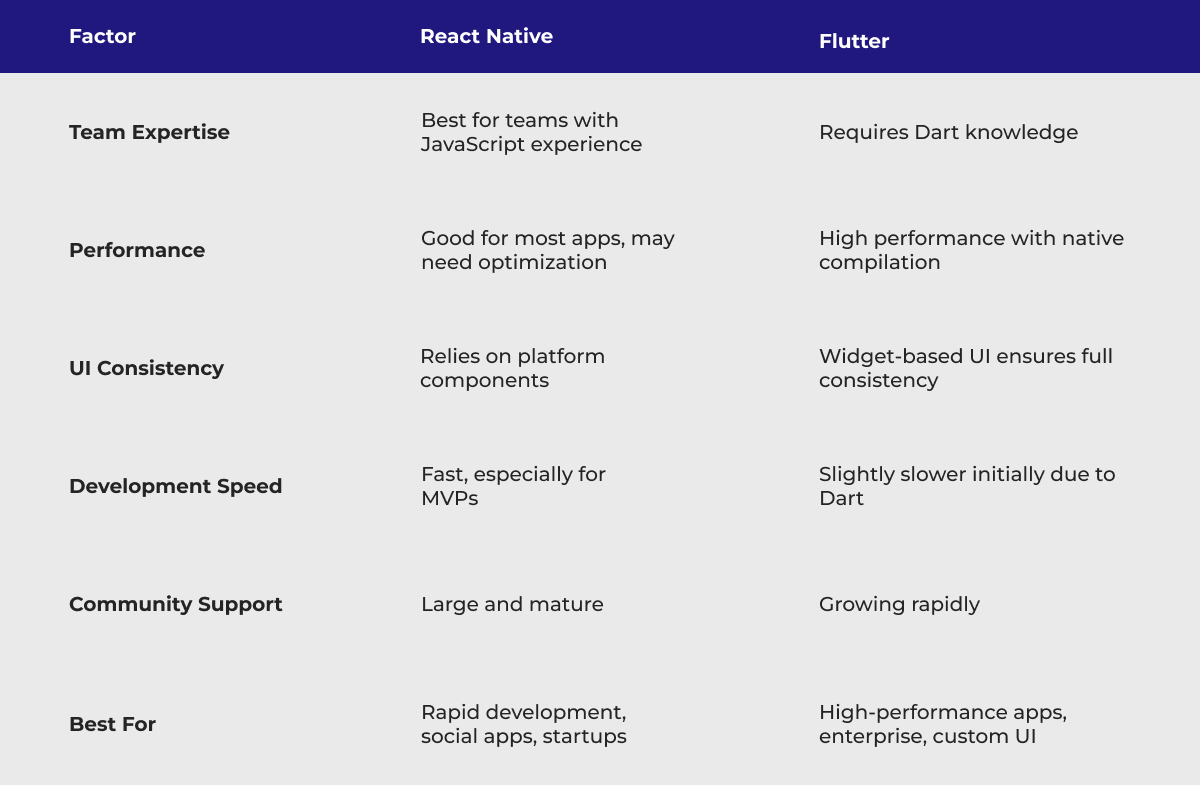
Key Takeaway: Choose React Native if your team is JavaScript-savvy and you need quick time-to-market. Choose Flutter for apps requiring performance, rich UI, and cross-platform consistency.
React Native vs Flutter: Cost Comparison
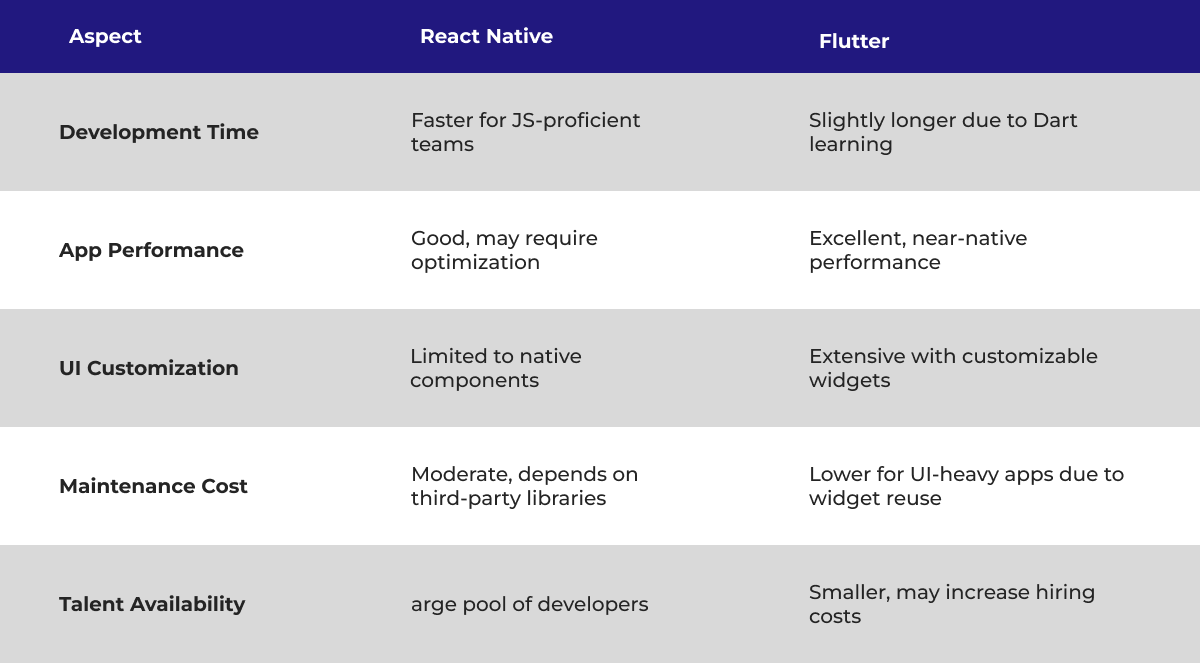
Insight:
- React Native is cost-effective for MVPs and startups.
- Flutter may have slightly higher initial costs but reduces long-term UI development cycles for complex apps.
Best Enterprise Use Cases
React Native:
- Integration with existing web platforms using React.
- Social media, e-commerce, and content delivery apps.
- Enterprises aiming for rapid prototyping and MVPs.
Flutter:
- Apps requiring high performance and custom UI designs.
- Cross-platform solutions for mobile, web, and desktop.
- Enterprise applications with complex animations and high visual fidelity.
Expert Verdict
“Both React Native and Flutter are excellent choices for cross-platform development. React Native remains strong for projects leveraging JavaScript expertise, while Flutter shines in high-performance and design-intensive apps. The choice should be guided by team skills, app complexity, and business objectives.” — Industry Expert
Frequently Asked Questions
Q1: Which framework is better for startups?
A: React Native is ideal for startups aiming for rapid MVP development. Flutter is better for startups needing high-performance, design-rich apps.
Q2: Can Flutter be used for web and desktop apps?
A: Yes, Flutter supports mobile, web, and desktop, enabling a unified codebase.
Q3: Is Dart difficult to learn?
A: Dart is beginner-friendly, especially for developers familiar with object-oriented programming.
Q4: Which framework has stronger community support?
A: React Native has a larger community, but Flutter’s community is rapidly growing and well-supported by Google.