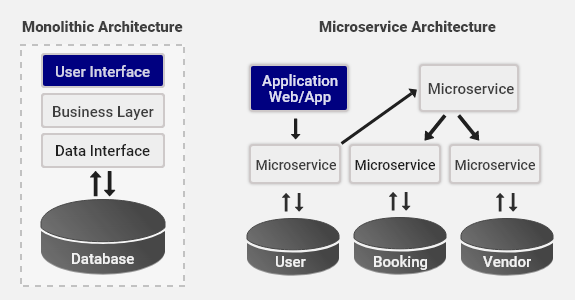
Software architecture has evolved significantly over the past decade. Modern businesses now demand scalability, flexibility, faster deployment, and high availability—all of which have led to the rise of Microservices Architectureover traditional Monolithic Architecture.
Tech giants like Netflix, Amazon, and Google have successfully adopted microservices to achieve rapid innovation and massive scalability. But does that mean microservices are always the right choice?
In this detailed guide, we will explain:
- What monolithic and microservices architectures are
- Key differences between them
- Pros and cons of each approach
- Real‑world examples
- When to choose microservices over monolithic
What Is Microservices Architecture?
Microservices architecture is a software development approach where a large application is built as a collection of small, independent services, each focused on a specific business capability.
Each microservice:
- Runs in its own process
- Communicates via APIs (REST, gRPC, messaging queues)
- Can be developed, deployed, and scaled independently
- Aligns closely with business functionality
Because of this independence, teams can release features faster, improve reliability, and scale only the required components instead of the whole system.
What Is Monolithic Architecture?
A monolithic application is built as a single unified codebase where all components are tightly connected and deployed together.
Typical layers of a monolithic system include:
- Database layer – SQL or NoSQL storage
- Client‑side UI – HTML, CSS, JavaScript
- Server‑side logic – Handles business rules, HTTP requests, and data processing
In monolithic architecture:
- All modules share the same memory and runtime
- A small change requires rebuilding and redeploying the entire application
- Scaling means duplicating the whole application, not just one feature
Example: A traditional Java web application packaged as a single JAR/WAR deployed on Tomcat or a .NET MVC application.
Monolithic vs Microservices: Key Differences
| Feature | Monolithic Architecture | Microservices Architecture |
|---|---|---|
| Codebase | Single, tightly coupled | Multiple independent services |
| Deployment | Entire app redeployed | Independent deployment per service |
| Scalability | Scale whole system | Scale specific services |
| Technology stack | Usually single stack | Polyglot (multiple technologies) |
| Fault isolation | Failure can crash whole app | Failure isolated to one service |
| Development speed | Slower as app grows | Faster parallel development |
| Complexity | Simple initially | Complex infrastructure required |
Advantages of Microservices Architecture
1. Agility and Faster Development
Microservices break large applications into small, independently deployable services, allowing teams to develop, test, and release features without affecting the entire system. This dramatically reduces delivery cycles from months to weeks and supports continuous integration and deployment (CI/CD).
2. Better Scalability
Only the services experiencing heavy traffic—such as payments, search, or authentication—need to scale. This targeted scaling optimizes infrastructure usage, reduces operational cost, and improves overall system performance.
3. Improved Resilience and Fault Isolation
If one microservice fails, it does not bring down the entire application. This isolation improves system uptime, reliability, and user experience, which is critical for high‑traffic digital platforms.
4. Technology Flexibility
Each service can use the most suitable programming language, framework, or database for its function. This polyglot approach enables innovation and prevents long‑term technology lock‑in.
5. Reusability Across Multiple Channels
Well‑designed, business‑centric APIs allow the same services to power web apps, mobile apps, partner integrations, and third‑party platforms, accelerating digital expansion.
Disadvantages of Microservices Architecture
Despite its benefits, microservices introduce additional complexity:
- Higher operational overhead requiring DevOps maturity, containerization, orchestration (e.g., Kubernetes), and monitoring tools
- Complex testing and debugging across distributed services and environments
- Network latency and communication failures between services during heavy load
- Increased infrastructure and maintenance cost, especially for small projects or startups
- Strong dependency on automation, observability, and engineering discipline
Advantages of Monolithic Architecture
Monolithic systems remain valuable—especially in early product stages:
- Simple architecture that is easy to build, deploy, and manage
- Straightforward testing and debugging within a single codebase
- Lower infrastructure and operational cost for small to mid‑size applications
- Faster MVP development with minimal DevOps requirements
Disadvantages of Monolithic Architecture
As applications grow, monoliths face scalability and agility challenges:
- Difficult to scale individual features independently
- Slower development velocity due to tightly coupled code
- Single point of failure that can impact the entire system
- Harder to adopt new technologies or frameworks incrementally
- Large deployments increase downtime risk and release complexity
When Should You Choose Microservices?
Choose Microservices If Your Application:
- Requires high scalability, availability, and performance
- Has multiple development teams working in parallel
- Needs frequent feature releases and continuous delivery
- Serves large user bases or high transaction volumes
- Must integrate with multiple external or third‑party systems
Avoid Microservices If:
- You are building an MVP, prototype, or small product
- Your team lacks DevOps, cloud, or distributed system expertise
- Budget, infrastructure, or timeline are limited
In such cases, starting with a modular monolith and evolving later is often the most practical strategy.
Real‑World Microservices Example
A modern e‑commerce platform typically consists of independent microservices such as:
- User authentication and authorization
- Product catalog management
- Search and filtering
- Payment processing
- Reviews and ratings
Each service runs independently, communicates through APIs or event streams, and can be scaled or deployed without affecting the rest of the system—enabling high performance, resilience, and rapid innovation.
Future of Microservices in 2026 and Beyond
Microservices continue to evolve with:
- Kubernetes and container orchestration
- Serverless microservices
- AI‑driven monitoring and auto‑scaling
- Event‑driven architectures
However, many organizations now adopt a hybrid or modular monolith approach to balance complexity and scalability.
Conclusion
Both Monolithic and Microservices architectures have their place in modern software development.
- Monolithic is ideal for small to mid‑size applications and MVPs.
- Microservices is best for large‑scale, high‑traffic, rapidly evolving platforms.
Choosing the right architecture depends on business goals, team maturity, scalability needs, and budget—not just industry trends.