Running out of essential medicines mid-week is a nightmare. Over-ordering expensive consumables that expire on the shelf is a drain on your budget. Losing track of critical supplies across multiple rooms creates real patient safety risks.
These are not hypothetical problems. They happen every day in South African healthcare facilities from GP practices in Johannesburg to community clinics in the Eastern Cape.
Manual inventory tracking is no longer good enough. It is slow, error-prone, and simply cannot keep up with the demands of modern healthcare.
Fortunately, Artificial Intelligence (AI) is changing that. South African healthcare providers are now using AI-powered inventory tools to reduce waste, cut costs, stay compliant, and always have the right supplies on hand.
In this guide, we explain exactly how AI inventory management works. We also cover why it matters in South Africa specifically, and what to look for when choosing a solution.
The Inventory Problem in South African Healthcare
South African clinics and hospitals face a unique set of pressures. Therefore, inventory management is particularly challenging here.
Budget constraints hit hard, especially for smaller private practices. Every rand wasted on expired stock or duplicate orders cannot go toward patient care.
Supply chain disruptions are also a constant challenge. Global medicine shortages, local logistics delays, and currency fluctuations make procurement unpredictable. Because of this, facilities need smarter and more adaptive systems.
Regulatory compliance adds further complexity. SAHPRA requires strict tracking of medicines and medical devices. Facilities that cannot produce accurate stock records face serious regulatory risk.
Expiry management is another chronic problem. Without automated tracking, expired stock often goes unnoticed. This is especially common in high-volume environments where dozens of product lines need monitoring.
Finally, most South African healthcare SMEs simply do not have the admin capacity to manage inventory manually at the level required today.
What AI-Powered Inventory Management Actually Does
AI does not just digitise your stockroom. Instead, it makes your stockroom genuinely intelligent. Here is what modern AI inventory systems deliver.
Predictive Demand Forecasting
AI analyses your historical usage patterns, patient volumes, and seasonal trends. Based on this data, it forecasts exactly how much stock you will need and when.
For example, a GP practice can automatically anticipate higher antibiotic demand during winter. A multi-branch physiotherapy group can sync stock levels across sites based on appointment volumes. This removes guesswork from procurement entirely.
Automated Reordering
When stock drops below a set threshold, AI triggers purchase orders to approved suppliers automatically. Because of this, you avoid stockouts without any manual chasing. Approval layers can be added for governance, without slowing things down significantly.
Expiry Date Tracking and Alerts
AI monitors expiry dates across every product and sends automatic alerts in advance typically at 90, 60, and 30-day intervals. Therefore, your team can rotate stock efficiently and avoid costly write-offs.
Real-Time Inventory Dashboards
Instead of doing a physical stock count, AI gives you a live dashboard on any device. Stock levels, order statuses, supplier lead times, and usage trends are all visible in one place. As a result, procurement decisions become faster and more accurate.
Anomaly Detection
Unexpected spikes in usage? Unexplained stock discrepancies? AI flags these immediately. This allows your team to investigate problems early before they escalate or create compliance issues.
Supplier Performance Tracking
Additionally, advanced AI platforms track supplier reliability over time. They monitor lead times, delivery accuracy, and pricing trends across vendors. This data supports smarter procurement and stronger supplier negotiations going forward.
Real-World Benefits for South African Healthcare Providers
The benefits of AI inventory management are practical and measurable. Here is how they translate for South African facilities:
| Benefit | Real-World Impact |
|---|---|
| Reduced stock waste | Up to 30% less expired or over-ordered stock |
| Lower procurement costs | Better forecasting eliminates panic buying at premium prices |
| Staff time recovered | Hours of manual counting eliminated each week |
| Regulatory compliance | Automated audit trails aligned with SAHPRA requirements |
| Improved patient care | Critical supplies reliably available when needed |
| Cash flow optimisation | Less capital tied up in excess stock |
For a small private clinic on tight margins, even a modest reduction in stock waste can be transformational. For larger multi-site operations, the efficiency gains compound significantly across locations.
Is AI Inventory Management Right for Your Practice?
A common misconception is that AI tools are only for large hospital groups. However, that is no longer true.
Small and medium-sized clinics often see the fastest ROI from AI inventory tools. Here is why:
- Tighter budgets mean waste hits proportionally harder
- Smaller admin teams benefit most from automation every saved hour goes back to patient care
- Cloud-based tools need no expensive on-site infrastructure or dedicated IT staff
- Most platforms use subscription pricing that scales with practice size
Whether you run a single-doctor family practice, a multi-branch dental group, or a corporate occupational health clinic, AI inventory tools are accessible and affordable today.
The question, therefore, is not whether the investment makes sense. For most South African healthcare providers, it clearly does. The real question is which platform best fits your specific context.
What to Look for in an AI Inventory Solution — South Africa Specific Considerations
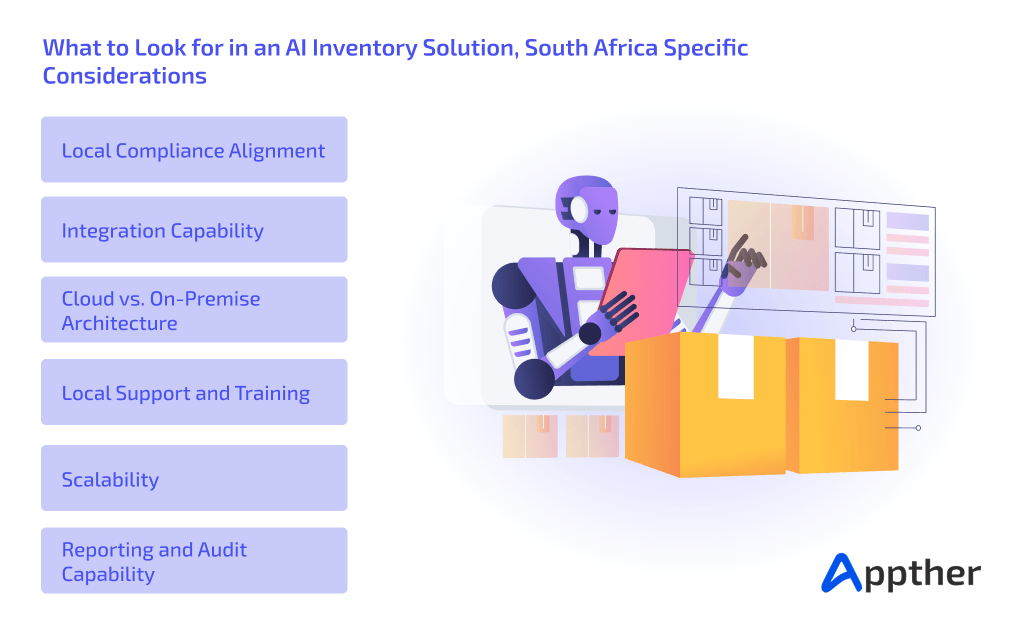
When evaluating platforms, it is important to apply a locally-informed lens. Here are the key factors to consider:
Local Compliance Alignment
Does the system support SAHPRA documentation requirements? Additionally, is it built with POPIA-compliant data handling? These are non-negotiable starting points for any South African healthcare provider.
Integration Capability
Can the platform connect with your existing practice management software, EHR system, or billing platform? Siloed tools that do not communicate with the rest of your operations create new inefficiencies rather than solving existing ones.
Cloud vs. On-Premise Architecture
Cloud-based solutions offer easier updates, lower costs, and remote access. This is especially important for multi-site operations and clinic managers who need visibility outside working hours. However, ensure the provider has a strong data security posture before committing.
Local Support and Training
Is there South African-based support available? Or will you be relying on overseas helpdesks in different time zones? Implementation support and ongoing training are often the difference between successful adoption and a system nobody uses.
Scalability
Will the platform grow with your practice? A solution that works for your current single-site setup should also support future expansion without requiring a complete system change later.
Reporting and Audit Capability
For medical aid billing, SAHPRA inspections, and internal governance, robust reporting is essential. Therefore, look for platforms that generate documentation in formats aligned with South African regulatory expectations.
Frequently Asked Questions (FAQs)
Q: Do I need a large IT team to implement AI inventory management?
No. Most modern AI inventory platforms are designed for healthcare businesses without dedicated IT resources. Because they are cloud-based, most systems can be set up within days, with guided onboarding provided by the vendor.
Q: Is AI inventory management SAHPRA and POPIA compliant?
Reputable platforms are built with healthcare compliance in mind. However, you should always verify that any solution supports SAHPRA medicine tracking and handles data in line with POPIA. Ask the vendor for a compliance overview before signing any agreement.
Q: How long does it take to see a return on investment?
Most South African healthcare facilities report measurable improvements reduced waste, time savings, fewer stockouts within two to three months. Full ROI timelines vary based on facility size and how manual the previous process was.
Q: Can AI inventory tools integrate with my existing practice management system?
Many AI platforms offer integration with popular practice management and billing systems. Therefore, this is an important question to ask during your evaluation. Seamless integration avoids double-entry and keeps your inventory data aligned with actual patient activity.
Q: What happens if the system goes offline?
Cloud-based platforms maintain data security through redundant servers and regular backups. Most providers offer uptime guarantees and offline access to recent data snapshots. This is especially important in South Africa, given load-shedding disruptions.
Q: Does AI inventory management cover all healthcare supplies, or only medicines?
AI inventory management covers everything — medicines, consumables, medical devices, PPE, and equipment. The system tracks all product categories simultaneously, giving you one unified view of your entire supply position.
Q: How does predictive forecasting work if my patient volumes are unpredictable?
Seasonal variability is exactly what AI forecasting is built for. The system learns from your historical data over time. As a result, it produces increasingly accurate predictions — even for facilities with highly variable patient volumes.
Q: What does an AI inventory management platform cost for a small South African clinic?
Pricing varies by platform, number of users, and feature scope. Most cloud-based solutions use monthly subscription models. Entry-level options are often accessible for smaller practices at a cost that is quickly offset by waste reduction and time savings. It is best to request a tailored quote based on your specific facility size and needs.
Conclusion
The case for AI-powered inventory management in South African healthcare is clear. Tightening margins, rising regulatory scrutiny, supply chain complexity, and growing patient expectations all point in the same direction.
AI inventory management is not a future-state aspiration. It is a practical, accessible, and affordable tool that South African healthcare providers of every size can implement today.
The right platform, properly integrated and locally aligned, does more than reduce waste and cut costs. It frees your team to focus on what matters most delivering excellent patient care.