Why Ethiopian Banks Need AI Chatbots Now
Ethiopia is experiencing one of the most ambitious digital transformation journeys on the African continent. With the Digital Ethiopia 2030 strategy now in full swing, Addis Ababa emerging as a smart city hub, and the fintech market projected to reach USD 820 million by 2034, the pressure on Ethiopian banks to modernize customer service has never been greater. At the heart of this transformation lies a powerful yet underutilized technology: AI-powered chatbots capable of serving customers in Amharic, the country’s most widely spoken language.
Consider the current landscape. The Commercial Bank of Ethiopia (CBE) serves tens of millions of account holders. Awash Bank, Dashen Bank, Bank of Abyssinia, and other private institutions are racing to digitize their services. Mobile banking adoption has surged, with over 58 million mobile money customers across the country. Yet most of these banks still rely on manual customer service processes — long call center queues, crowded branch lobbies, and limited after-hours support. For a population where Amharic is the primary language of communication, English-only digital interfaces create an additional barrier to financial inclusion.
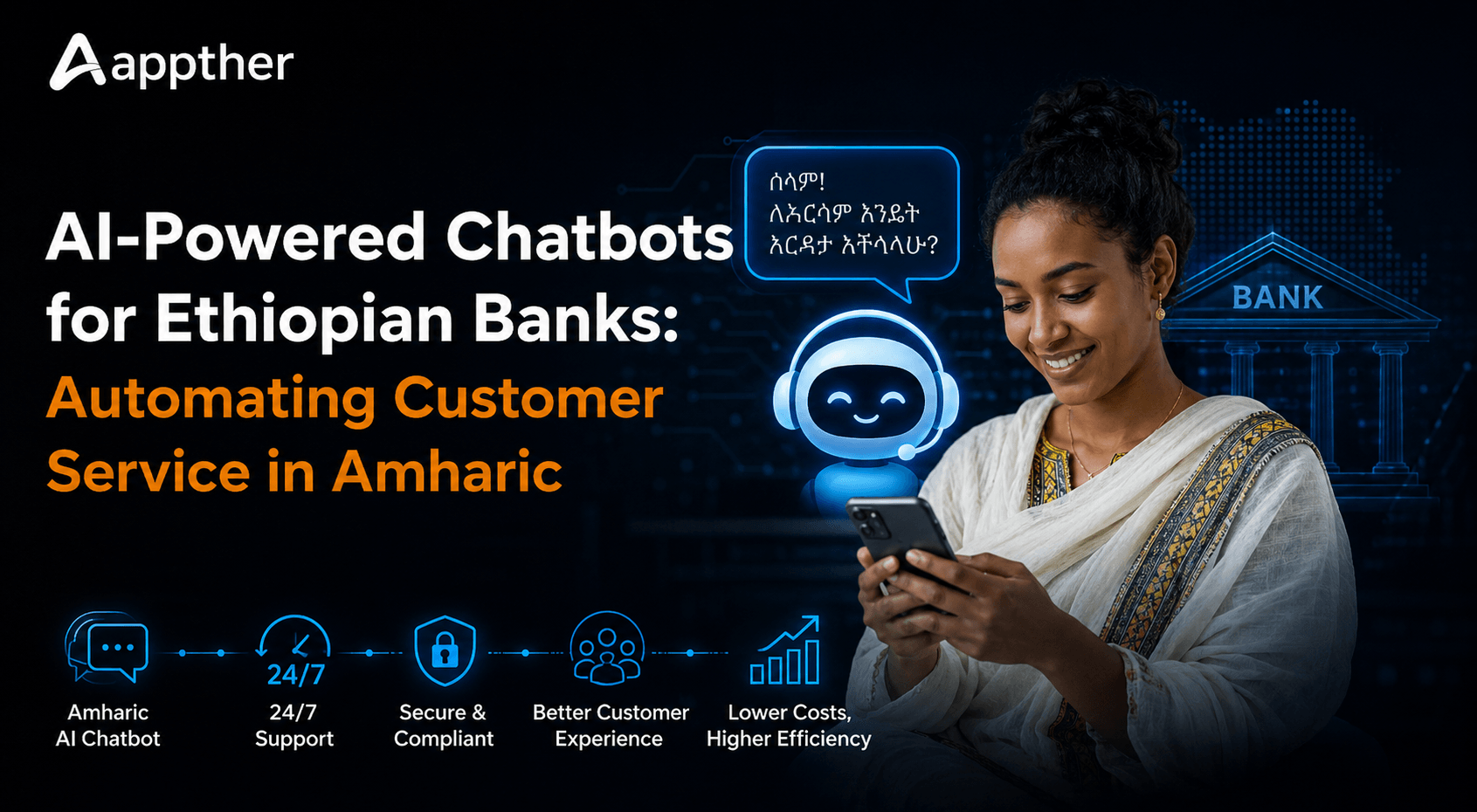
This is where AI-powered chatbots change the game. By deploying intelligent conversational AI systems that understand, process, and respond in Amharic, Ethiopian banks can deliver 24/7 customer support, reduce operational costs by up to 30 percent, and dramatically improve the customer experience. In this comprehensive guide, we explore how AI chatbots work for the Ethiopian banking sector, the unique challenges and opportunities of Amharic natural language processing (NLP), real-world use cases, implementation strategies, and why 2026 is the year for Ethiopian banks to act.
The State of Digital Banking in Ethiopia in 2026
Ethiopia’s banking sector has undergone a remarkable evolution over the past five years. The telecom liberalization that brought Safaricom into the market alongside Ethio Telecom has expanded mobile network coverage to over 85 percent of the population. Internet users have climbed to approximately 47 million, and the country now hosts more than 500 tech startups in Addis Ababa alone. The government’s Fayda National Identity System connects 132 institutions and supports digital services across 476 agencies, creating a robust infrastructure for digital financial services.
The National Bank of Ethiopia (NBE) launched Phase Two of its national digital payments strategy, focusing on interoperability, expanded digital ID integration, and deeper adoption of electronic payment systems. Ethiopian fintech startups like Chapa, ArifPay, and Kifiya are building payment gateways, merchant services, and digital lending platforms. Banks are responding by upgrading their mobile apps — CBE, Awash Bank, and Dashen Bank have all launched improved mobile banking applications with features including balance inquiries, fund transfers, bill payments, and QR code transactions.
However, a critical gap remains. While the transactional infrastructure has improved, customer service and engagement remain largely analog. Most banks handle customer inquiries through call centers staffed during business hours, with limited capacity for the volume of questions generated by millions of newly digitized customers. AI-powered chatbots represent the logical next step — bridging the gap between digital transaction capabilities and truly digital customer engagement.
What Are AI-Powered Banking Chatbots?
An AI-powered banking chatbot is an intelligent software application that uses natural language processing (NLP), machine learning (ML), and conversational AI to simulate human-like conversations with bank customers. Unlike basic rule-based bots that follow rigid scripts, modern AI chatbots can understand context, interpret customer intent, handle complex multi-step queries, and learn from every interaction to improve over time.
For Ethiopian banks, the most critical capability is Amharic language support. An AI chatbot built for the Ethiopian market must be able to process Amharic script (Ge’ez/Fidel), understand Amharic grammar structures, recognize colloquial expressions, and respond naturally in the language that customers are most comfortable with. This goes far beyond simple translation — it requires purpose-built NLP models trained specifically on Amharic text and conversational patterns.
Key Components of a Banking Chatbot
- Natural Language Understanding (NLU): Interprets what the customer is saying, identifies intent (e.g., “check my balance” vs. “report a lost card”), and extracts relevant entities such as account numbers, dates, and amounts.
- Dialogue Management: Maintains conversation context across multiple exchanges, enabling the chatbot to handle follow-up questions and multi-step processes like loan applications or dispute resolution.
- Backend Integration: Connects securely with the bank’s core banking system, CRM, payment gateways, and authentication services through APIs to execute real transactions and retrieve real-time account data.
- Multilingual Engine: Supports Amharic as the primary language while also handling English, and potentially Afan Oromo, Tigrinya, and Somali for broader reach across Ethiopia’s diverse population.
- Security Layer: Implements end-to-end encryption, biometric authentication, session management, and compliance with NBE data protection regulations.
Why Amharic Language Support Is a Game-Changer
Amharic is spoken by over 50 million people and serves as the official working language of the Ethiopian federal government. For banks operating in Addis Ababa and across the country, offering customer service exclusively in English excludes a massive portion of the customer base. The challenge, however, is that Amharic is classified as a low-resource language in the NLP research community — meaning there are fewer pre-trained models, datasets, and tools available compared to languages like English, Spanish, or even Swahili.
Despite this, significant progress has been made. Research initiatives such as EthioNLP and Masakhane have developed Amharic language models, sentiment analysis tools, and named entity recognition systems. The EthioLLM project has produced multilingual large language models specifically designed for five Ethiopian languages including Amharic and Ge’ez. Lesan AI, a Berlin-based startup with Ethiopian roots, has built automated translation tools for Amharic and Tigrinya. These academic and startup innovations are creating the foundation upon which commercial-grade Amharic chatbot solutions can be built.
Unique Challenges of Amharic NLP for Chatbots
- Script Complexity: Amharic uses the Ge’ez (Fidel) script with over 230 characters, making tokenization and text processing more complex than Latin-script languages.
- Morphological Richness: Amharic is a morphologically rich language where a single word can convey what would require an entire phrase in English. This makes intent detection and entity extraction more challenging.
- Limited Training Data: Compared to English, there are far fewer labeled conversational datasets in Amharic. Building a banking chatbot requires curating domain-specific Amharic training data from scratch.
- Code-Switching: Many Ethiopian professionals switch between Amharic and English within the same conversation. A robust chatbot must handle this seamlessly.
- Dialect Variations: Regional variations in Amharic expressions require the chatbot to understand and respond appropriately regardless of the customer’s specific dialect.
For banks considering chatbot deployment, partnering with an AI development company that has experience in both multilingual NLP and banking domain expertise is essential. The solution must be purpose-built for the Ethiopian context — not a generic chatbot with a translation layer.
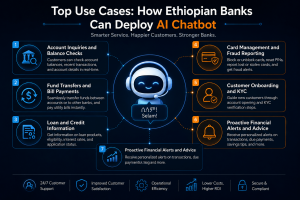
Top Use Cases: How Ethiopian Banks Can Deploy AI Chatbots
1. Account Inquiries and Balance Checks
Customers can ask their balance, view recent transactions, and check account status in Amharic via WhatsApp, Telegram, or the bank’s mobile app — without waiting in line or calling a help desk. Given that Telegram is one of the most widely used messaging platforms in Ethiopia, deploying a chatbot on Telegram alone can reach millions of users instantly.
2. Fund Transfers and Bill Payments
Authenticated chatbots can guide customers through fund transfers between accounts, bill payments for utilities, and even merchant payments — all through a conversational Amharic interface. The chatbot handles authentication via OTP or biometric verification, ensuring secure transactions.
3. Loan and Credit Information
AI chatbots can answer questions about loan eligibility, interest rates, required documentation, and repayment schedules. For banks like CBE that process thousands of loan inquiries daily, this automation reduces branch workload significantly while ensuring customers receive accurate, consistent information.
4. Card Management and Fraud Reporting
Lost or stolen card? An AI chatbot can instantly lock the card, initiate a replacement request, and guide the customer through the fraud reporting process — all in Amharic, available 24/7. This immediate response capability is critical for preventing financial losses.
5. Customer Onboarding and KYC
With the Fayda digital ID system now connecting 132 institutions, AI chatbots can streamline new account opening by guiding customers through KYC document submission, identity verification, and account setup — reducing the time from days to minutes.
6. Proactive Financial Alerts and Advice
Advanced chatbots can send proactive notifications about low balances, unusual transactions, upcoming loan payments, or new product offerings — all personalized and delivered in the customer’s preferred language.\
Business Benefits: The ROI of AI Chatbots for Ethiopian Banks
| Benefit | Impact for Ethiopian Banks |
| 24/7 Availability | Serve customers outside business hours, including weekends, holidays, and during peak periods like month-end salary deposits |
| Cost Reduction | Reduce customer service operational costs by 25–30% by automating routine inquiries that currently require human agents |
| Scalability | Handle thousands of simultaneous conversations — critical during events like new product launches or system outages |
| Financial Inclusion | Serve Amharic-speaking customers who are excluded by English-only digital interfaces, expanding the bank’s addressable market |
| Data Insights | Capture and analyze customer interaction data to identify trends, pain points, and product opportunities |
| Branch Decongestion | Reduce foot traffic at physical branches in Addis Ababa by resolving common queries digitally |
| Faster Resolution | Resolve standard customer inquiries in under 60 seconds compared to 10–15 minutes via phone or branch visit |
Globally, leading banks have already demonstrated the transformative impact of AI chatbots. Bank of America’s virtual assistant Erica processes over 2 million daily interactions and has surpassed 3 billion total client interactions. While Ethiopian banks operate at a different scale, the proportional benefits are equally compelling — particularly for institutions like CBE that serve tens of millions of customers with limited branch infrastructure in rural areas.
How to Build an Amharic AI Chatbot for Banking: Implementation Roadmap
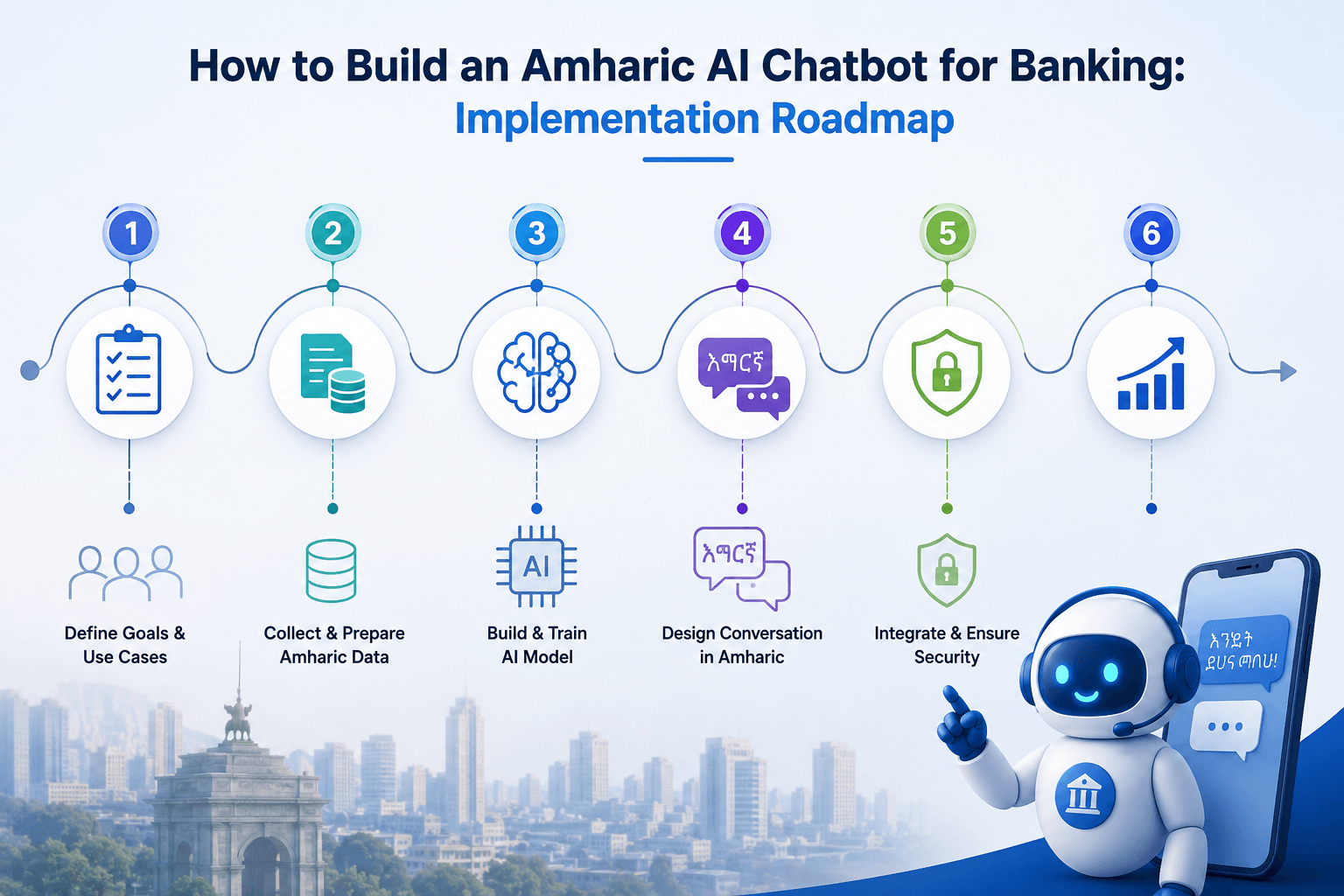
Phase 1: Discovery and Data Preparation (Weeks 1–4)
- Audit existing customer service channels (call center logs, branch queries, mobile app feedback) to identify the top 50–100 most common customer inquiries.
- Curate Amharic conversational training data specific to banking terminology, including common phrases used in branch interactions.
- Define integration requirements with the bank’s core banking system (e.g., Temenos, Oracle FLEXCUBE, or locally developed platforms).
- Establish security and compliance requirements aligned with NBE directives and data protection guidelines.
Phase 2: NLP Model Development (Weeks 5–10)
- Train or fine-tune an Amharic NLP model using banking-specific datasets, leveraging pre-trained multilingual models like Afro-XLM-R as a foundation.
- Build intent classification and entity extraction pipelines for banking use cases (balance inquiry, transfer request, complaint, loan query, etc.).
- Develop the dialogue management system with support for multi-turn conversations and context retention.
- Implement code-switching detection for customers who mix Amharic and English.
Phase 3: Integration and Testing (Weeks 11–14)
- Integrate the chatbot with core banking APIs for real-time data retrieval and transaction execution.
- Deploy across target channels: Telegram, WhatsApp, the bank’s mobile app, and web portal.
- Conduct extensive testing with native Amharic speakers across different demographics, including urban and rural users.
- Perform security penetration testing and compliance validation.
Phase 4: Launch and Continuous Improvement (Weeks 15+)
- Soft launch with a segment of customers, gather feedback, and iterate on the NLP model’s accuracy.
- Implement analytics dashboards to track chatbot performance: resolution rate, customer satisfaction, escalation rate, and response time.
- Establish a continuous learning pipeline where the chatbot improves from new conversations and edge cases.
- Expand language support to include Afan Oromo, Tigrinya, and Somali based on customer demand.
Choosing the Right AI Chatbot Development Partner
Selecting the right technology partner for AI chatbot development is critical to success. Ethiopian banks should evaluate potential partners based on the following criteria:
- Proven experience in conversational AI and banking domain chatbot development, with a portfolio of 350+ projects delivered globally.
- Deep expertise in NLP for low-resource languages, particularly Amharic and other Ethiopian languages.
- Capability to integrate with multiple core banking systems and payment gateways, including EthSwitch and local fintech APIs.
- Strong security practices including end-to-end encryption, compliance with international data protection standards, and understanding of NBE regulatory requirements.
- Agile development methodology with transparent project management, milestone-based delivery, and post-launch support.
- Omnichannel deployment capability across Telegram, WhatsApp, mobile apps, USSD, and web platforms.
Appther Technologies brings all of these capabilities to the table. As an AI-first software development company with extensive experience in conversational AI, machine learning, and mobile app development, Appther has delivered over 350 projects globally across healthcare, fintech, education, and enterprise sectors. Our team specializes in building intelligent chatbot solutions that combine cutting-edge NLP with deep domain expertise, ensuring Ethiopian banks get a solution that is purpose-built for their specific market needs.
The Future: AI Chatbots and Ethiopia’s Digital 2030 Vision
Ethiopia’s digital trajectory is unmistakable. The African Union has appointed Ethiopia’s Prime Minister as Champion of Artificial Intelligence and Digital Health. The country has established Africa’s first AI Institute and is building the world’s second AI University. The Digital Ethiopia 2030 strategy explicitly prioritizes AI applications in healthcare, agriculture, education, and financial services. For banks, this creates both an imperative and an opportunity.
Banks that deploy AI chatbots now will be positioned to take advantage of several converging trends: the growing interoperability between payment systems (driven by NBE’s Phase Two strategy), the expanding Fayda digital ID ecosystem (enabling seamless KYC), the rollout of Ethiopia’s first domestic credit cards (by SanuPay), and the entry of international fintech players into the market. AI chatbots will serve as the primary customer interaction layer for this new era of Ethiopian banking — the banks that invest early will capture customer loyalty and market share.
Furthermore, as Google’s AI Overviews and generative search increasingly shape how customers discover and evaluate banking services, banks with AI-powered digital touchpoints will enjoy significantly greater visibility and credibility in search results. Chatbot interactions generate structured data that feeds back into the bank’s digital presence, creating a virtuous cycle of improved search visibility, customer acquisition, and service delivery.
Frequently Asked Questions (FAQs)
1. Can AI chatbots really understand and respond in Amharic accurately?
Yes. While Amharic is classified as a low-resource language, significant advancements in multilingual NLP models such as Afro-XLM-R and EthioLLM have made it possible to build high-accuracy Amharic chatbots. When trained on domain-specific banking data, these models can achieve accuracy rates above 85 percent for intent detection and entity extraction. The key is working with a development partner that has expertise in both Amharic NLP and banking domain knowledge.
2. How much does it cost to develop an AI chatbot for an Ethiopian bank?
The cost depends on the scope and complexity of the project. A basic FAQ chatbot with Amharic support may start from USD 15,000–25,000, while a full-featured transactional chatbot integrated with core banking systems, supporting multiple channels and languages, typically ranges from USD 40,000–80,000. The ROI is typically realized within 6–12 months through reduced call center costs and improved customer satisfaction.
3. Which messaging platforms are most effective for deploying banking chatbots in Ethiopia?
Telegram is the most widely used messaging platform in Ethiopia, making it the highest-priority deployment channel. WhatsApp is also growing in adoption, particularly among diaspora customers. Beyond messaging apps, deploying the chatbot within the bank’s own mobile app and on its website ensures maximum coverage. For customers in areas with limited internet connectivity, USSD-based chatbot interfaces can extend reach to basic phone users.
4. Is it safe to conduct banking transactions through a chatbot?
Absolutely. Modern AI banking chatbots implement multiple layers of security including end-to-end encryption, two-factor authentication (OTP), biometric verification, session timeouts, and transaction limits. These security measures meet or exceed the standards required by the National Bank of Ethiopia. The chatbot should also include real-time fraud detection capabilities and automatic escalation to human agents for suspicious activities.
5. How long does it take to develop and deploy a banking chatbot?
A typical end-to-end implementation takes 14–18 weeks, broken into four phases: discovery and data preparation (4 weeks), NLP model development (6 weeks), integration and testing (4 weeks), and launch with continuous improvement (ongoing). Banks can accelerate the timeline by starting with a focused scope (e.g., top 20 FAQs) and expanding capabilities incrementally.
6. Can the chatbot handle multiple Ethiopian languages beyond Amharic?
Yes. A well-architected chatbot can be designed with a multilingual framework from the start, with Amharic as the primary language and modules for Afan Oromo, Tigrinya, Somali, and English. The EthioLLM research project has already demonstrated the viability of multilingual language models covering five Ethiopian languages. Additional languages can be added progressively based on customer demand and data availability.
7. What is the difference between a rule-based chatbot and an AI-powered chatbot?
A rule-based chatbot follows pre-defined scripts and decision trees — it can only answer questions it has been explicitly programmed to handle. An AI-powered chatbot uses machine learning and natural language understanding to interpret customer intent, handle variations in phrasing, manage multi-turn conversations, and learn from new interactions over time. For banking applications where customers express the same need in hundreds of different ways, AI-powered chatbots deliver dramatically better results.
8. How does an AI chatbot integrate with existing bank systems?
The chatbot connects to the bank’s core banking system, CRM, payment infrastructure, and authentication services through secure APIs. For Ethiopian banks using platforms like Temenos, Oracle FLEXCUBE, or locally developed systems, the chatbot’s integration layer is custom-built to communicate with these specific backends. The integration ensures real-time data retrieval, transaction processing, and seamless handoff to human agents when needed.
Conclusion: The Time to Act Is Now
The convergence of Ethiopia’s digital infrastructure expansion, regulatory modernization, fintech growth, and AI advancement has created a once-in-a-generation opportunity for Ethiopian banks to leapfrog traditional customer service models. AI-powered chatbots with native Amharic language support are not a luxury — they are becoming a competitive necessity in a market where digital-first customers expect instant, personalized, and accessible service.
Whether you are the Commercial Bank of Ethiopia serving tens of millions, a growing private bank like Awash or Dashen, or a fintech startup building the next generation of financial services, the technology to deliver world-class Amharic-speaking AI customer service is available today. The question is not whether to deploy AI chatbots, but how quickly you can move to capture the advantage.
Ready to Build an AI-Powered Chatbot for Your Ethiopian Bank?
Appther Technologies specializes in AI chatbot development, conversational AI, and NLP solutions for banking and fintech.
Contact us today for a free consultation and project scoping session.