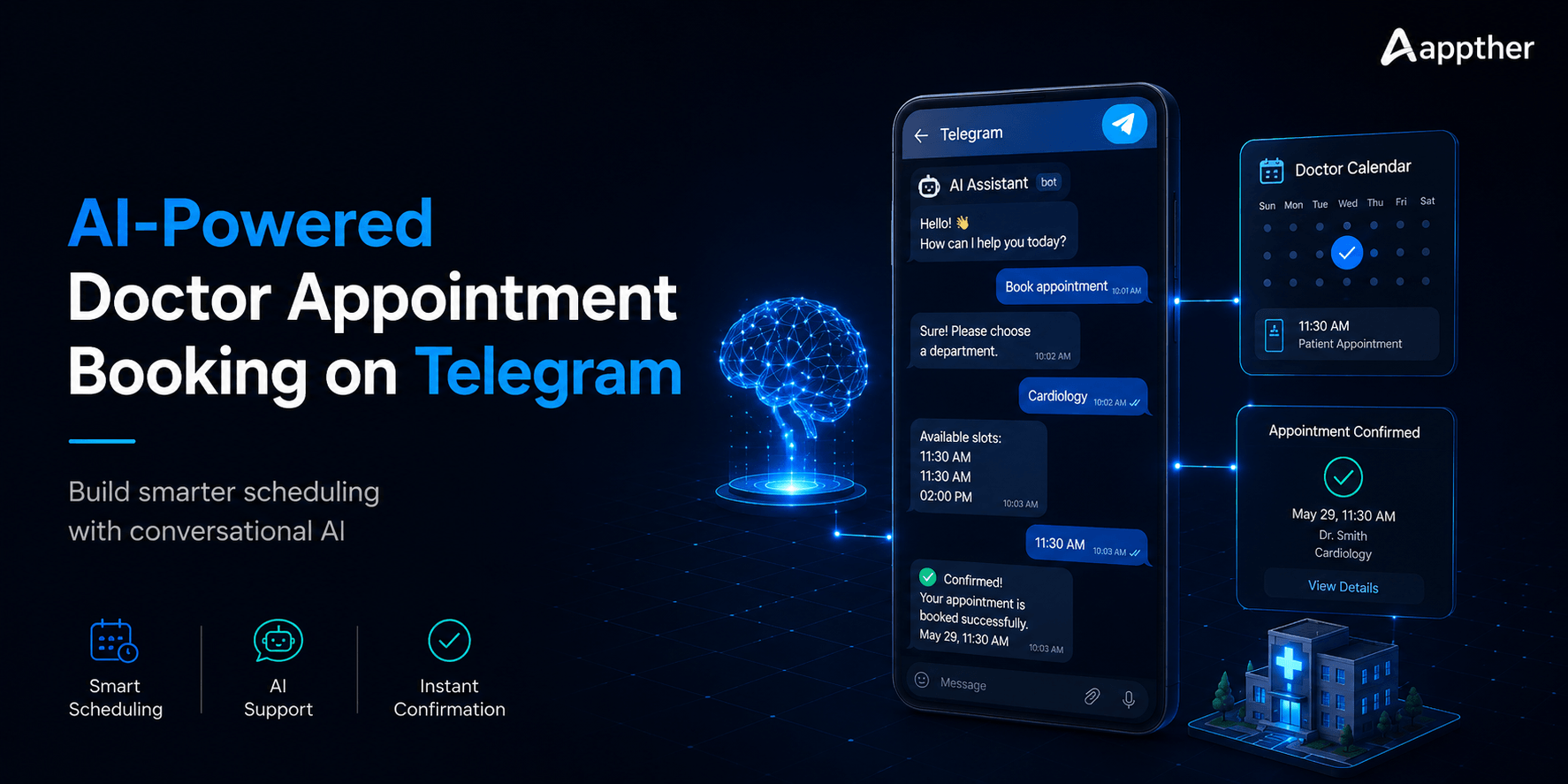
Picture this. A patient feels unwell at 10 PM. The clinic is closed. The phone rings out. So they do what most people do now: they open their phone, pull up Telegram, and type a message. Within seconds, an AI assistant replies, checks the doctor’s availability, confirms a slot, and sends a reminder. No waiting. No frustration. No missed booking.
That is not a distant future scenario. Clinics across India, Southeast Asia, and the Middle East are running this exact setup today, and the results are genuinely hard to argue with. Booking times that once took a phone call and several minutes of back-and-forth are now averaging around 45 seconds. Patient satisfaction scores at multi-specialty practices using Telegram-based bots have crossed 85 percent in documented case studies.
This post breaks down what an AI-powered doctor booking system on Telegram actually involves, why the combination of AI and Telegram specifically makes sense, what it takes to build one, and where the real business value sits for clinics and hospitals. Whether you run a single-doctor practice or a 50-bed hospital, this guide is written for you.
Why Telegram? Not WhatsApp, Not an App, Not a Website
This is the question that comes up almost every time we talk to a clinic about messaging-based automation. WhatsApp has more users globally, websites are familiar, and apps seem more professional. So why Telegram?
The honest answer has several parts.
The bot infrastructure is genuinely superior.
Telegram’s Bot API is open, well-documented, and free to use at scale. Unlike WhatsApp Business API, which requires verified business accounts, third-party approval, and per-message pricing at higher volumes, Telegram lets you build and deploy a bot with no platform fees. For a clinic with tight margins, that matters.
Telegram just got a major upgrade for bots.
In May 2026, Telegram rolled out bot-to-bot communication, allowing automated systems to share data and coordinate workflows directly between each other. This opens up use cases like AI agents that check real-time doctor availability, confirm with a scheduling system, and update a CRM record, all without a human touching anything. That kind of multi-agent coordination was not cleanly possible before.
Real usage data backs it up.
One documented clinic deployment showed that 30 percent of all appointment bookings were happening through Telegram. Not via the website. Not by phone. Through Telegram, because patients had it open anyway and found it faster than any other channel.
It works on low-end phones.
In markets like India, parts of Africa, and Southeast Asia, Telegram runs reliably on older Android devices with slower connections. An appointment booking app that requires 150MB of storage and a fast connection loses patients before they even get started. Telegram is already installed. The barrier drops to zero.
What an AI Doctor Booking System on Telegram Actually Does
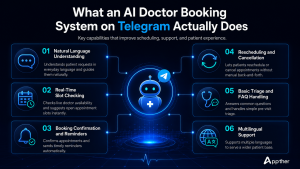
Before we get into how it is built, let us be specific about what it does. The phrase ‘AI chatbot’ gets thrown around loosely, so here is a realistic breakdown of the capabilities a properly built system covers.
1. Natural Language Understanding
A patient might type ‘I need to see a skin doctor next week’ or ‘appointment for my mother, she has knee pain.’ The AI reads the intent, extracts the specialty needed, and responds accordingly, rather than making the patient select from a rigid menu. This is where large language models like Claude or GPT come in. They handle messy, real-world language far better than older rule-based bots.
2. Real-Time Slot Checking
The bot connects to the clinic’s scheduling system or a Google Calendar/Calendly integration. It pulls live availability for the relevant doctor and presents options. No double bookings. No outdated slots. The patient sees what is actually open.
3. Booking Confirmation and Reminders
Once a slot is chosen, the system confirms it instantly and saves the record. It then sends automated reminders: typically 24 hours before the appointment and again two hours before. This alone reduces no-shows significantly. One study tracking AI tools for clinics in 2026 found that no-show rates dropped sharply at practices using automated reminder workflows.
4. Rescheduling and Cancellation
Life happens. A patient messages to cancel. The bot handles it, frees the slot, and if configured, offers an alternative time or puts the patient on a waitlist. No staff involvement needed.
5. Basic Triage and FAQ Handling
The AI can answer common questions: clinic timings, location, parking, what to bring, whether the doctor handles a particular condition. This removes a large chunk of the routine calls that eat into front desk time every day.
6. Multilingual Support
For clinics serving diverse populations, the system can handle multiple languages within the same conversation. A patient switches from English to Hindi mid-sentence, and the AI follows along. This is one of the harder things to do well with rule-based systems, and one of the areas where AI-native approaches genuinely shine.
The Technology Stack Behind It
You do not need to be a developer to understand this section. Think of it as the ingredients list. The specifics can vary, but here is how most production-grade Telegram doctor booking systems are built in 2026.
- Telegram Bot API: The interface through which messages come and go. Every interaction passes through here.
- AI language model (Claude API, OpenAI GPT, or similar): Handles understanding and generating natural language responses.
- Workflow automation layer (n8n, Make, or custom Node.js): Connects the AI to calendars, CRMs, and databases. Think of this as the coordinator that routes data to the right place.
- Scheduling integration (Google Calendar, Calendly, or proprietary systems): Reads real-time availability and writes confirmed bookings.
- Database (Supabase, Firebase, or similar): Stores patient records, booking history, and conversation context.
- Notification system: Sends reminders via Telegram messages on schedule.
One stack that has become quite popular for this kind of project is Telegram Bot API + Claude AI + n8n + Supabase. The reason is pragmatic: n8n handles complex workflow logic visually without heavy custom code, Supabase gives a reliable open-source database with a clean API, and Claude handles nuanced conversation better than keyword-matching bots.
At Appther, we have built similar AI agent systems for clients where the core requirement was intelligent automation over a messaging channel, and the architectural patterns translate well to healthcare scheduling.
The Business Case: What Clinics Actually Gain
Technology adoption in healthcare tends to slow down when the ROI is not clearly visible. So let us be direct about where the value shows up.
Front Desk Time Recovered
A busy clinic with 60 patients a day spends significant staff time just handling appointment calls, confirmations, and rescheduling. If even 40 percent of those interactions shift to the Telegram bot, that is real hours given back to staff for tasks that actually require human judgment.
Reduced No-Shows
Empty appointment slots are quietly one of the most expensive problems in clinic management. Automated reminders with easy rescheduling links cut the rate of patients who simply forget to show up. When a slot opens due to cancellation, the system can automatically notify the next patient on the waitlist.
After-Hours Coverage
The bot is available at midnight just as readily as at noon. Patients who decide they need an appointment at 11 PM can book it without waiting for morning. For working adults who cannot make calls during business hours, this convenience is not a nice-to-have. It directly determines whether they book with your clinic or go elsewhere.
Scalability Without Proportional Hiring
A clinic that grows from 30 to 120 patients a day does not need to triple the front desk team. The bot scales with volume. The staff handles the work that genuinely needs them.
Patient Privacy for Sensitive Appointments
This point often gets overlooked. Some patients are uncomfortable calling to book appointments for mental health, sexual health, or other sensitive concerns. Typing to a bot on Telegram feels more private than speaking to a receptionist. That perception matters, and it translates to more bookings in categories that might otherwise see patients delay care.
What a Patient Conversation Actually Looks Like
Here is a realistic example of how the exchange flows. This is not a rigid script. The AI adapts based on what the patient says.
Patient: Hi, I need to see a dermatologist. Can I get an appointment this week?
Bot: Of course! Dr. Mehra has availability on Wednesday at 10:30 AM or Thursday at 4:00 PM. Which works better for you?
Patient: Thursday please.
Bot: Perfect. Could I get your name and the number on which we can confirm?
Patient: Priya Kapoor, this number is fine.
Bot: Your appointment is confirmed with Dr. Mehra on Thursday at 4:00 PM. We will send you a reminder on Wednesday evening. Is there anything else you need?
The entire exchange takes under two minutes. There are no forms, no hold music, no callback wait. The patient gets what they came for, and a record is automatically created in the clinic’s system.
Common Concerns Clinics Have, Answered Honestly
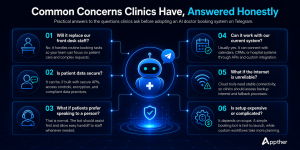
What if the AI gets something wrong?
This is the most common concern, and it deserves a direct answer. AI language models do make mistakes. The design of a good system accounts for this. Complex or ambiguous queries are flagged for human review. The bot is not the last line of defense, it handles the bulk of routine interactions cleanly while the staff handles edge cases.
What about patient data and privacy?
A properly built system stores minimal data, uses encrypted connections, and keeps conversation data on servers controlled by the clinic rather than third-party platforms. Compliance requirements vary by country, so this is an important conversation to have during the build phase. It is solvable, but it needs deliberate architecture.
Will patients actually use it?
The data suggests yes, particularly among patients under 45. In documented clinic implementations, adoption rates for messaging-based booking have been strong enough that some practices have made Telegram their primary booking channel within six months of launch.
How long does it take to build?
A production-ready system with the core features described in this post typically takes four to eight weeks to build, test, and deploy. The timeline depends on how complex the scheduling integrations are and whether custom workflows are required.
Getting Started: What You Need Before You Build
If this sounds like something your clinic or hospital should have, here is a practical starting checklist.
- A Telegram account and a registered bot via @BotFather (takes about five minutes)
- A clear view of your current scheduling system and whether it has an API or can be connected to Google Calendar
- Defined workflows: which specialties, which doctors, what booking rules apply
- A list of the 20 most common patient questions your front desk handles every week
- A decision on what language or languages the bot should support
- A development partner who has built conversational AI systems before, not just a bot template
The last point matters more than most clinic managers initially assume. A template-based bot handles simple flows. An AI-native system handles the reality of how patients actually communicate, which is messier, more conversational, and occasionally in two languages at once.
Why This Is Particularly Relevant in 2026
The healthcare AI market is not slowing down. The global healthcare chatbot segment is projected to reach close to two billion dollars by 2032, growing at nearly 20 percent annually. The direction of travel is clear.
More practically, Telegram’s 2026 platform updates have made bot capabilities significantly more powerful. Bot-to-bot communication, guest bot access, and improved automation hooks mean that the systems being built this year are meaningfully more capable than what was possible 18 months ago.
Clinics that get this infrastructure in place now are not just solving a 2026 problem. They are building a patient communication layer that will handle far more over time, from lab result delivery to post-appointment follow-up to chronic condition check-ins.
Final Thought
The reason most clinics still rely on phone bookings is not that patients prefer calling. It is that an alternative worth switching to has not been made available to them yet. A well-built AI booking system on Telegram is not a gimmick. It is a functional, scalable improvement to one of the most friction-heavy parts of the patient experience.
The technology is ready. The platform is ready. The only variable is whether your clinic decides to use it.
If you want to explore what this would look like for your practice, we are happy to walk you through a realistic scope and timeline. Appther has built production AI agent systems across healthcare, real estate, and enterprise contexts. The conversation starts with a clear understanding of what you actually need, and goes from there.