Every manufacturing company eventually reaches the same crossroads. Your spreadsheets are maxed out, your teams are working with disconnected data, and production visibility is close to zero. You know it is time for an ERP system. But then comes the next big question: should you go with a cloud ERP or stick with an on-premise deployment?
This is not a simple yes or no decision. Your choice will shape how your factory operates, what your IT team manages, how much you spend over the next decade, and how quickly you can adapt to change. In 2026, with manufacturing margins tighter than ever and supply chains still unpredictable, picking the wrong ERP architecture can be a costly mistake.
This guide breaks down the real differences between cloud ERP and on-premise ERP for manufacturing companies, covering cost, security, scalability, customization, and implementation time, so you can make the right call for your business.
What Is Cloud ERP and What Is On-Premise ERP?
Before diving into the comparison, it helps to be clear about what each model actually means in a manufacturing context.
Cloud ERP is hosted on remote servers managed by the ERP vendor or a third-party cloud provider such as AWS, Azure, or Google Cloud. You access the system through a web browser or mobile app, pay on a subscription basis, and the vendor takes care of infrastructure, security patches, backups, and upgrades. Popular cloud ERP platforms for manufacturers include Odoo (cloud-hosted), NetSuite, SAP S/4HANA Cloud, and Microsoft Dynamics 365.
On-Premise ERP is installed directly on your company’s own servers and managed by your internal IT team. You pay a one-time perpetual license fee, own the software outright, and take full responsibility for maintenance, upgrades, hardware, and security. Traditional on-premise systems include SAP ECC, Oracle E-Business Suite, and the self-hosted Community edition of Odoo.
Both models can handle the same core manufacturing functions including Bill of Materials (BOM), production planning, MRP, inventory management, procurement, and shop floor control. The fundamental difference lies in how the system is delivered, maintained, and paid for over time.
A Side-by-Side Snapshot Before We Go Deep
To give you a quick reference before we explore each dimension in detail, here is how cloud ERP and on-premise ERP stack up across the factors that matter most to manufacturers.
| Factor | Cloud ERP | On-Premise ERP |
|---|---|---|
| Upfront Cost | Low, subscription-based | High, license plus hardware |
| Total Cost Over 10 Years | Predictable and lower overall | Higher due to maintenance and IT overhead |
| Implementation Time | Weeks to a few months | Typically 6 to 18 months |
| IT Requirements | Minimal, vendor manages infrastructure | Requires a dedicated internal IT team |
| Upgrades | Automatic, handled by vendor | Manual, often costly and disruptive |
| Customization Depth | Moderate, API-driven | Deep, source-code-level access |
| Data Control | Vendor-hosted, SLA-governed | Full in-house control |
| Scalability | Highly scalable on demand | Requires hardware investment to scale |
| Remote Access | Yes, from anywhere and any device | Limited unless VPN is configured separately |
| Disaster Recovery | Built in, vendor responsibility | Must be built and maintained in-house |
| Best Suited For | Growing SMBs and multi-site manufacturers | Regulated industries with deep customization needs |
1. Cost: What Manufacturers Actually Pay Over Time
Cost is usually the first point of debate in this conversation, and also the most misunderstood one.
On-premise ERP looks cheaper upfront. You pay a one-time perpetual license, purchase the hardware, and the subscription line item disappears from your P&L. For a 50-user manufacturing operation, that might look like $75,000 to $150,000 upfront, which feels like a contained, one-time investment.
But that is only the beginning of the story. Once you add ongoing IT staff salaries, server maintenance contracts, security management, manual upgrade projects (which routinely cost between $50,000 and $200,000 each), backup infrastructure, and the financial impact of unplanned downtime, the picture changes dramatically. Research consistently shows that on-premise ERP total cost of ownership (TCO) runs 30 to 70 percent higher than cloud ERP when measured over a 10-year period.
Cloud ERP spreads the cost very differently. You pay a monthly or annual subscription per user, ranging from around $30 per user per month on platforms like Odoo to over $300 per user per month on SAP S/4HANA Public Cloud. These costs are predictable and operational in nature (OpEx rather than CapEx), which matters significantly for manufacturers who need to protect cash flow and avoid large capital commitments.
The break-even point is worth understanding clearly. Most cost analyses show that on-premise becomes price-competitive at roughly the two-year mark if you only look at software and subscription fees. But when you factor in full TCO, including upgrade costs, IT overhead, and downtime risk, cloud ERP holds its cost advantage across most time horizons.
Bottom line for manufacturers: Cloud ERP wins on total cost for the majority of small to mid-size manufacturers. On-premise may make financial sense if you already have significant server infrastructure, a large in-house IT team, and require heavy customization that would drive up cloud subscription costs over time.
2. Implementation Speed: Getting Live Faster Reduces Risk
Downtime and delays in manufacturing are expensive in a very literal sense. Every week your ERP implementation stretches longer is another week your team is still running on spreadsheets, chasing manual purchase orders, and making production decisions without real-time data.
Cloud ERP implementations move significantly faster. Because infrastructure is already in place, modules come pre-configured, and there is no hardware to procure or rack-and-stack, you can go live in as little as 8 to 16 weeks for a mid-size single-site manufacturer. For Odoo cloud implementations covering manufacturing, inventory, and accounting together, well-executed projects routinely complete within 3 to 6 months.
On-premise implementations are slower by nature and not because of any failure on the vendor’s part. Hardware must be sourced, installed, and tested. Custom configurations need to be built and validated on-site. Integrations with shop floor equipment, SCADA systems, and existing legacy tools require more setup time and physical access. For a mid-size manufacturing business, expect 6 to 12 months for a standard deployment and 12 to 18 months or more for complex, multi-site rollouts.
Bottom line for manufacturers: Cloud ERP delivers faster time to value. If your operations are under pressure and you need a working system in place within the year, cloud is the more reliable path.
3. Customization and Control: Where On-Premise Still Has a Real Advantage
This is the area where on-premise ERP genuinely shines, and where manufacturers with complex or highly specialized operations need to think carefully before committing to a cloud-only approach.
On-premise ERP gives you full access to the source code and underlying database. You can build custom modules from scratch, deeply modify existing workflows, integrate with proprietary machinery communication protocols, and create configurations that simply are not possible in most cloud environments without significant workarounds or middleware layers. For manufacturers producing highly engineered or custom products such as aerospace components, specialized industrial equipment, or Engineer-to-Order (ETO) goods, this level of flexibility can be genuinely non-negotiable.
Cloud ERP has improved dramatically in the area of customization over the past several years. Platforms like Odoo, for example, offer extensive customization through a modular architecture and a robust developer API, without requiring on-site deployment. However, limits still exist. Cloud vendors control the infrastructure layer. Major version upgrades can break heavily customized environments. And some deep integrations with legacy factory equipment require middleware that adds both cost and architectural complexity to your environment.
Bottom line for manufacturers: If your needs fall in the range of standard to moderate customization, cloud ERP handles it well in 2026. If your manufacturing processes are highly unique, heavily regulated, or involve deep system integrations with proprietary equipment or legacy systems, on-premise gives you more control, though it comes at a real cost in time and maintenance effort.
4. Security and Data Compliance: Time to Rethink the Old Assumptions
Many manufacturing executives instinctively feel that on-premise is more secure because the data sits in their own building, under their own roof, within their own network perimeter. In 2026, that assumption deserves careful scrutiny.
Enterprise cloud ERP vendors invest heavily in security infrastructure that most individual manufacturers simply cannot match. ISO 27001 certification, SOC 2 compliance, end-to-end encryption, multi-factor authentication, and 24/7 dedicated security monitoring are standard offerings from major cloud ERP providers. For most small to mid-size manufacturers, the cloud vendor’s security posture is substantially stronger than what an internal IT team can realistically maintain alongside its other responsibilities.
On-premise does offer one genuine and important advantage in this area: data sovereignty. Your data never leaves your premises, which matters considerably for manufacturers operating in defense, government contracting, or highly regulated sectors. Pharmaceutical GMP compliance, aerospace AS9100 standards, and automotive IATF 16949 certification requirements can, in some cases, demand that sensitive IP and production records remain on internal servers under the manufacturer’s direct control.
Bottom line for manufacturers: For the majority of manufacturing businesses, cloud ERP is at least as secure as on-premise and frequently more so. The meaningful exception is highly regulated industries where data sovereignty, air-gapped network requirements, or specific compliance certifications require on-site infrastructure.
5. Scalability: Planning for Growth Without Infrastructure Headaches
Manufacturing businesses grow, and they also adapt to seasonal demand swings, new product lines, geographic expansion, and M&A activity. Your ERP system needs to scale comfortably alongside those changes rather than becoming a bottleneck.
Cloud ERP scales on demand without friction. Adding users, activating additional modules, or expanding capacity for a new facility does not require hardware investment or lengthy infrastructure planning. A manufacturer opening a second plant in another region can extend the same cloud ERP instance within days, with users up and running almost immediately.
On-premise ERP scales with considerably more effort. More users typically mean more server capacity, additional licenses, and IT work to expand the environment. For manufacturers with stable headcounts and a single-site operation, this is not a pressing concern. For those growing quickly or managing operations across multiple sites, on-premise infrastructure can become a real operational bottleneck.
Bottom line for manufacturers: Cloud ERP is the clear winner on scalability, especially for multi-site operations, businesses entering new markets, or companies in an active growth phase.
6. Remote Access and Mobile Usability in the Modern Factory
Remote access to ERP data has gone from a convenience to a genuine operational requirement in manufacturing. Plant managers checking production status from off-site, procurement teams approving purchase orders from a mobile device, and executives reviewing real-time dashboards while traveling are now standard expectations rather than exceptions.
Cloud ERP is built for exactly this kind of access. Because the system runs through a web browser or mobile app, anyone with proper credentials and a reliable internet connection can log in from any location and any device. Most cloud ERP platforms now include responsive mobile interfaces specifically designed for shop floor workers, enabling them to log production completions, record inventory movements, and flag quality issues directly from a tablet or phone without returning to a desktop terminal.
On-premise ERP can be made accessible remotely through VPN tunnels and web portals, but doing so requires additional infrastructure setup, security configuration, and ongoing IT management. Mobile capabilities on traditional on-premise systems tend to be more limited unless custom applications or third-party tools are built specifically on top of the core system.
Bottom line for manufacturers: Cloud ERP delivers remote access and mobile usability as standard features, without additional configuration cost or complexity.
Which ERP Deployment Is Right for Your Manufacturing Business?
Here is a practical decision framework based on where your business actually stands today.
Cloud ERP is the stronger fit if your business is:
A small to mid-size manufacturer with fewer than 500 employees, growing quickly or planning to expand into additional facilities, running standard manufacturing processes such as make-to-order, make-to-stock, or batch production, working with a small or lean internal IT team, looking for faster implementation and lower upfront capital investment, or operating across multiple locations or in multiple countries.
On-Premise ERP deserves serious consideration if your business is:
A large manufacturer with a well-resourced in-house IT department, operating in a highly regulated industry such as defense, pharmaceutical, or government contracting where strict data residency requirements apply, running deeply specialized production processes that require source-code-level customization, already owning significant server infrastructure that reduces the capital argument for cloud, or located in a facility with unreliable internet connectivity that would make cloud access operationally risky.
What About Odoo? Cloud or On-Premise for Manufacturers?
If you are evaluating Odoo for your manufacturing operation, which is one of the most cost-effective and flexible ERP platforms available today, you have both deployment options available, and the right choice depends on your specific situation.
Odoo.sh is Odoo’s own managed cloud platform. It handles hosting, automatic upgrades, daily backups, and performance monitoring, while still giving you the freedom to install custom modules and run a tailored Odoo environment specific to your manufacturing workflows. For most small and mid-size manufacturers, this represents the ideal middle ground: cloud convenience combined with far more customization freedom than typical SaaS platforms allow.
Odoo Community (self-hosted) is the open-source version that you deploy and manage on your own servers. The software itself is free, the customization possibilities are nearly unlimited, but the system requires genuine technical expertise to maintain reliably, especially as your operation grows and your Odoo version ages.
Odoo Enterprise, available either as a cloud subscription or as an on-premise deployment with an annual license, adds the advanced manufacturing features that production-focused businesses need most: MRP II, work center planning, quality control, maintenance management, and real-time shop floor reporting.
For the majority of manufacturers considering Odoo in 2026, the cloud-hosted Odoo Enterprise or Odoo.sh path delivers the best balance of cost, manufacturing functionality, and realistic implementation speed. If you want to understand which Odoo edition or deployment model fits your specific operation, our team at Appther can walk you through a side-by-side assessment.
You can also read our detailed Odoo 17 vs Odoo 19 comparison to understand what has changed across recent versions, and our Odoo vs SAP vs NetSuite breakdown if you are still deciding which ERP platform fits your manufacturing business best.
Five Mistakes Manufacturers Make When Choosing Between Cloud and On-Premise
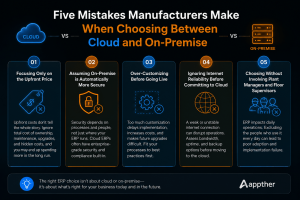
Focusing only on the upfront price. The total cost of ownership over 5 to 10 years tells a very different story than the initial quote. Factor in IT staff costs, maintenance contracts, upgrade projects, and the real financial cost of downtime before making any decision.
Assuming on-premise is automatically more secure. Most cloud ERP vendors operate security infrastructure that far exceeds what a typical manufacturing company’s IT team can realistically maintain in-house. The “data in my building equals safe data” assumption no longer holds up in 2026.
Over-customizing before going live. Whether you choose cloud or on-premise, heavy customization in Phase 1 delays your go-live date and inflates implementation costs significantly. Start with the standard module configuration, get your team using the system, and then customize based on real operational feedback from the floor.
Ignoring internet reliability before committing to cloud. If your manufacturing facility has inconsistent or unreliable internet connectivity, cloud ERP carries genuine operational risk. Assess your connectivity honestly before signing any subscription contract.
Choosing without involving plant managers and floor supervisors. ERP adoption failures are rarely technical problems. They are people problems. The system cannot succeed if the people who will use it daily had no voice in the selection process. Their input on workflow logic, usability, and pain points is not optional.
Final Verdict: Cloud ERP Is the Right Starting Point for Most Manufacturers in 2026
The manufacturing industry has made its preference clear. The majority of new ERP selections in 2024 and 2025 went to cloud deployments, and that trend is accelerating in 2026. Lower total cost of ownership, faster implementation timelines, built-in scalability, automatic upgrades, and anywhere access from any device make cloud ERP the logical starting point for most manufacturing businesses evaluating their options today.
On-premise ERP absolutely still has a place in the market, primarily for large enterprises with specific regulatory requirements, deep customization needs that exceed what cloud platforms can accommodate, or significant existing infrastructure investments. But for the growing mid-market manufacturer looking to modernize operations, gain real-time production visibility, and implement a system within a reasonable timeframe without a large capital commitment, cloud ERP is the right answer in most scenarios.
If you want to explore which model fits your specific production environment, including an honest look at your customization requirements, compliance obligations, and budget reality, we are happy to have that conversation with you.
Ready to Implement ERP for Your Manufacturing Business?
At Appther Technologies, we specialize in ERP implementation for manufacturing companies, from initial process mapping and system selection through full deployment and post-go-live support. Whether you are evaluating Odoo, weighing cloud versus on-premise options, or ready to begin your implementation, our team can help you move forward with confidence.
Before you go, also check out our Odoo ERP Implementation Checklist for Manufacturing Companies to understand exactly what a well-planned rollout looks like from day one.
Frequently Asked Questions About Cloud ERP vs On-Premise ERP for Manufacturers
Q1. What is the main difference between cloud ERP and on-premise ERP for manufacturing companies?
The core difference comes down to where the system lives and who manages it. Cloud ERP runs on the vendor’s servers and is accessed through the internet, meaning the provider handles hosting, upgrades, backups, and security on your behalf. On-premise ERP is installed on servers inside your own facility and managed entirely by your internal IT team. For manufacturers, this distinction affects not just your IT workload but your upfront costs, implementation timeline, customization depth, and long-term flexibility.
Q2. Is cloud ERP secure enough for manufacturing businesses?
Yes, and for most manufacturing companies, cloud ERP is actually more secure than what an in-house IT team can realistically maintain. Leading cloud ERP providers operate under certifications such as ISO 27001 and SOC 2, with 24/7 security monitoring, end-to-end encryption, and automated threat detection built into the platform. The exception worth noting is manufacturers in defense, pharmaceutical, or government contracting sectors where data sovereignty regulations or air-gapped network requirements specifically demand that sensitive data remain on-site.
Q3. How much does cloud ERP cost compared to on-premise ERP for a mid-size manufacturer?
Upfront, on-premise ERP appears cheaper since you pay a one-time perpetual license rather than an ongoing subscription. However, when you factor in the full total cost of ownership including server hardware, IT staff salaries, manual upgrade projects, backup infrastructure, and unplanned downtime, on-premise ERP typically runs 30 to 70 percent more expensive than cloud ERP over a 10-year period. Cloud ERP subscription pricing for manufacturing platforms starts at around $30 per user per month on platforms like Odoo and rises to over $300 per user per month on enterprise-grade systems like SAP S/4HANA Public Cloud.
Q4. How long does it take to implement cloud ERP vs on-premise ERP in a manufacturing plant?
Cloud ERP implementations move significantly faster because the infrastructure is already in place and modules come pre-configured. A mid-size single-site manufacturer can typically go live within 8 to 16 weeks on a well-managed cloud ERP project. On-premise implementations require hardware procurement, physical installation, on-site configuration, and more complex integration work, which usually extends the timeline to 6 to 12 months for a standard deployment and up to 18 months or more for multi-site or highly customized rollouts.
Q5. Can I customize a cloud ERP system to fit my specific manufacturing processes?
Yes, modern cloud ERP platforms offer meaningful customization through modular architecture and developer APIs. Odoo, for example, allows manufacturers to build custom modules, configure workflows, and integrate with third-party systems without needing on-site deployment. That said, cloud platforms do have infrastructure limits that on-premise systems do not. If your manufacturing operation requires deep, source-code-level customizations or proprietary machine integrations that go beyond what standard APIs support, on-premise ERP gives you more control, though at a higher maintenance cost.
Q6. What happens to my data if I switch from on-premise ERP to cloud ERP?
Data migration is one of the most critical steps in any ERP transition and it requires careful planning regardless of which direction you are moving. When migrating from on-premise to cloud, your existing data including production records, inventory history, supplier information, and financial data needs to be cleaned, mapped to the new system’s structure, and validated before go-live. A qualified ERP implementation partner will include a structured data migration plan as part of the project scope. Rushing this step is one of the most common reasons ERP projects run over budget and over time.
Q7. Is cloud ERP suitable for manufacturers with multiple production sites?
Cloud ERP is particularly well suited for multi-site manufacturing operations. Because the system is hosted centrally and accessed through the internet, adding a new facility simply means extending user access and configuring the site’s specific workflows within the existing environment. There is no need to install and manage separate server infrastructure at each location. This makes cloud ERP a practical and cost-effective choice for manufacturers expanding into new geographies or managing operations across several plants.
Q8. Can cloud ERP work if my manufacturing facility has slow or unreliable internet?
This is a genuine consideration and one that should not be overlooked during your evaluation. Cloud ERP requires a reliable internet connection to function, and if your facility experiences frequent outages or has consistently slow connectivity, that creates a real operational risk. Some cloud ERP vendors offer offline or low-connectivity modes for specific functions, but these are limited. If internet reliability is a consistent problem at your location, it is worth either investing in a better connection before committing to cloud or honestly evaluating whether a hybrid or on-premise approach better suits your infrastructure reality.
Q9. What is a hybrid ERP deployment and is it worth considering for manufacturers?
A hybrid ERP approach means running some workloads on-premise while hosting others in the cloud. For example, a manufacturer might keep sensitive financial data and proprietary production logic on local servers while using cloud-hosted modules for procurement, HR, and customer management. This approach can address specific compliance or connectivity concerns while still capturing some of the flexibility and cost benefits of cloud. The tradeoff is increased integration complexity and ongoing management overhead in maintaining two environments. For most small to mid-size manufacturers, a well-configured cloud ERP is simpler and more cost-effective than a hybrid setup.
Q10. How do I know if Odoo cloud is the right ERP choice for my manufacturing business?
Odoo is a strong candidate for manufacturers who need a capable, flexible, and cost-effective ERP without the price tag of SAP or Oracle. The cloud-hosted Odoo Enterprise edition covers the full manufacturing stack including MRP, work center planning, quality control, maintenance management, and shop floor reporting, and it is available at a subscription price that most small to mid-size manufacturers can realistically afford. If you are running standard to moderately complex manufacturing processes and want to go live within a few months rather than a year or more, Odoo cloud is worth a serious look. Our team at Appther can walk you through a free assessment of whether Odoo fits your specific operation before you commit to anything.