| Quick answer
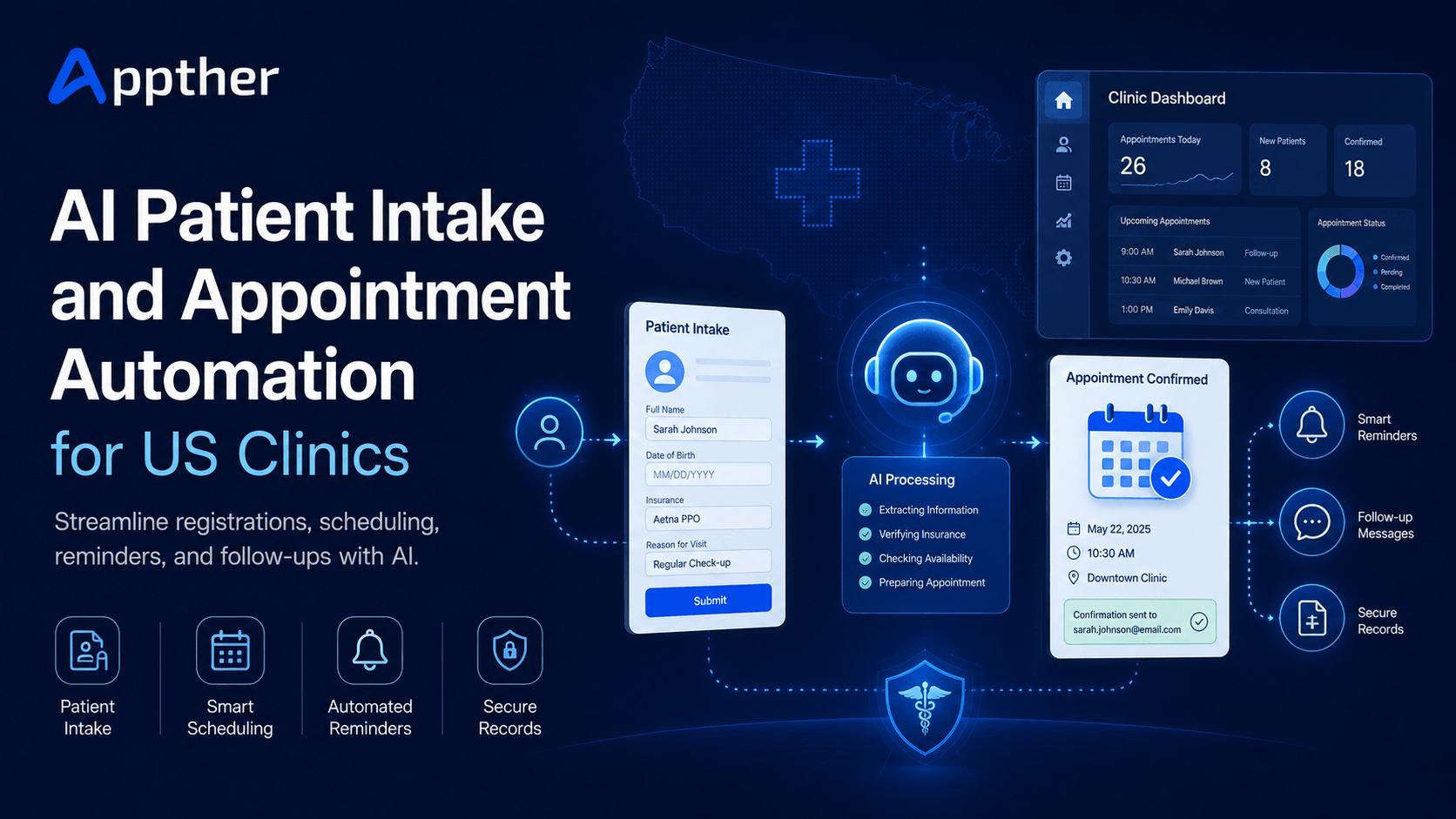
AI patient intake and appointment automation uses voice and chat agents to answer calls, collect patient details, verify insurance, and book or reschedule visits directly in your scheduling system. For US clinics, it works around the clock, cuts front-desk call volume, lowers no-shows, and routes anything sensitive to a human. The goal is not to replace your staff. It is to take the routine work off their plate so they can focus on patients. |
It is 9 PM on a Tuesday. A patient feels unwell and wants to book a visit. Your clinic is closed, the phone rings out, and the call goes to voicemail. By morning, that patient has already booked with the practice down the street that answered.
This happens more than most clinics realize. A large share of booking intent shows up after hours, and a missed call is often a lost patient, not a delayed one. Meanwhile, your front desk spends the day buried in phone tag, intake forms, and insurance questions.
There is now a better way to handle all of it. In this guide, we explain how AI patient intake and appointment automation works, what US clinics can automate today, and how to roll it out without disrupting the care your team already delivers.
What AI patient intake and appointment automation actually means
The term covers two connected jobs. Both sit at what clinics now call the digital front door, the first point of contact between a patient and your practice.
Appointment automation handles scheduling. An AI voice or chat agent answers the patient, understands what they need, checks real availability, and books, reschedules, or cancels the visit. It then sends a confirmation and reminders.
Patient intake automation handles the paperwork around the visit. The system collects demographics, insurance details, medical history, and consent before the patient arrives. So your staff are not retyping forms or chasing missing information on the day.
Put together, these two pieces turn a slow, manual front desk into a system that runs day and night. We go deeper on the booking side in our guide to doctor appointment booking app development.
The front-desk problems US clinics are trying to solve
Before the fix, it helps to name the pain. These are the issues we hear from clinic operators across the US.
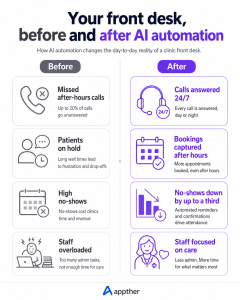
- Missed and after-hours calls: a big slice of booking demand lands when the desk is closed or busy, and those calls turn into lost patients.
- Phone tag and hold times: patients wait on hold, hang up, and try a competitor instead.
- No-shows: empty slots waste provider time and drain revenue from a tight schedule.
- Staff burnout: front-desk teams drown in routine calls, which pulls them away from patients in the waiting room.
- Manual intake: paper or PDF forms mean double data entry, errors, and slow check-ins.
- Insurance and eligibility checks: verifying coverage by phone eats hours every week.
- Language barriers: clinics serving diverse communities struggle to cover every patient in their own language.
Each problem is small on its own. Stacked together, they cap how many patients your clinic can serve well. So let us look at how automation clears them.
How the automation works, step by step
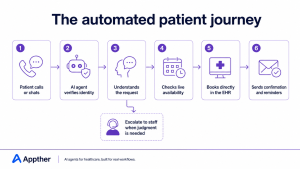
A modern AI agent does far more than read a script. Here is what a single after-hours booking call looks like from start to finish.
- The agent answers the call or chat instantly, with no hold music and no phone tree.
- It identifies the caller against your patient records and confirms their name and date of birth.
- The patient explains the need in plain language, for example a follow-up with Dr. Lee next week in the afternoon.
- The agent checks live availability in your scheduling system and offers real, open slots.
- Once the patient picks a time, the agent books it directly in the system and confirms out loud.
- It then sends a confirmation and a reminder sequence, and collects intake details before the visit.
If the request needs human judgment, the agent hands it off to your staff with full context. Nobody starts the conversation over. That handoff is the difference between a helpful tool and a frustrating one.
What US clinics can automate today
This is not future technology. Clinics are running these workflows right now. Here are the ones with the clearest payoff.
Booking, rescheduling, and cancellations
The agent handles the full scheduling lifecycle in natural conversation. Patients book new visits, move existing ones, or cancel, without ever navigating a menu. The schedule updates in real time, so double bookings do not happen.
24/7 after-hours coverage
The agent answers every call, at 2 PM or 2 AM. That alone captures bookings your clinic used to lose to voicemail. For many practices, after-hours capture is the single biggest win.
Digital intake and registration
Before the visit, the system collects demographics, insurance, history, and consent forms through chat or a secure link. Your front desk stops retyping forms, and check-in moves faster. Clean intake data also means fewer billing errors later.
Reminders and no-show recovery
Automated reminders by call, text, or chat keep appointments top of mind. When a patient cancels, the system can offer the open slot to someone on a waitlist. That recovers revenue that used to vanish.
Routine questions and refills
Patients ask the same things over and over: clinic hours, location, prep instructions, lab status, and refill requests. The agent answers these instantly, which clears the routine calls clogging your phone lines.
Why generic chatbots fall short in healthcare
Not every automation tool belongs in a clinic. A generic booking bot can take a message, but it cannot safely handle protected health information or book inside your EHR. That gap matters more than it sounds.
Healthcare conversations are full of nuance. A patient mentions a symptom, switches languages mid-sentence, or asks something the bot was never trained on. A tool built for restaurants or salons breaks at exactly these moments, and patients notice.
A healthcare-grade agent is different. It understands medical terms, follows privacy rules, verifies identity, and knows when to pull in a human. That is the line between a tool patients trust and one they hang up on.
The compliance and trust questions every US clinic must ask
Healthcare automation lives or dies on trust. A patient is sharing sensitive information, so the system has to meet a higher bar than a generic booking bot. Ask any vendor or partner these questions early.
- HIPAA and a signed BAA: the platform must be HIPAA compliant and sign a Business Associate Agreement with your clinic.
- Security certifications: look for SOC 2 controls, plus encryption of patient data both at rest and in transit.
- Data is not used to train public models: patient information should never feed a public large language model.
- Real EHR integration: the agent should read live availability and write the booking back into your system, not just collect a message for staff to action later.
- Human handoff: the agent must escalate sensitive or complex cases to a person, with context attached.
- Accuracy and latency: low response delay and reliable speech recognition decide whether patients can finish a task by voice.
The good news is that the technical foundation already exists. Nearly all US hospitals have adopted modern interoperability standards like HL7 FHIR, which lets external tools exchange scheduling and patient data in real time. That is why deep integration is realistic today, not years away. If your clinic runs on Odoo, we build these AI features as native modules inside your system, as covered on our Odoo services page.
The payoff: what clinics actually gain
The numbers tell the story. Here is where the return shows up.
First, fewer no-shows. Smart reminders and easy rescheduling can cut no-show rates by up to a third, which directly protects revenue on a full schedule.
Second, captured demand. Every after-hours call that used to hit voicemail can now become a booked visit. Industry analysts expect the large majority of healthcare providers to invest in conversational AI by this year, and after-hours capture is a big reason why.
Third, lower cost and freed-up staff. A full-time US receptionist costs roughly 30,000 to 45,000 dollars a year. An AI agent handles the routine load at a fraction of that, and your existing team gets to focus on patients instead of the phone.
Appther has built these systems for real clinics, including HIPAA-compliant chatbots and voice agents that cut call center volume sharply. You can read how we approach the build in our healthcare AI insights.
Beyond the front desk: where intake data pays off
The value does not stop at check-in. Clean intake data flows into the rest of your operation, and that is where it quietly compounds.
Accurate insurance details mean fewer denied claims and faster billing. Structured medical history means providers walk into the room already informed. And every booked visit, reminder, and follow-up becomes data you can study. Over time, you can spot no-show patterns, busy periods, and gaps in access. In other words, automating the front door also gives you a clearer view of the whole practice.
How to roll it out without disrupting your clinic
You do not flip a switch and replace your front desk overnight. The clinics that succeed start small and expand.
Begin with one high-volume workflow, usually appointment booking or after-hours coverage. Connect the agent to your existing phone number and scheduling system, so nothing about the patient experience feels foreign.
Run a short pilot. Measure the right things: calls answered, bookings captured after hours, no-show rate, and how often the agent hands off to staff. Listen to a sample of calls and refine the conversation flow.
Once the first workflow proves itself, add the next, for example digital intake or reminders. Each step builds on a system your team already trusts. A focused rollout like this usually goes live in a matter of weeks, not months.
This is where an experienced partner matters. Healthcare workflows are full of edge cases, and a generic bot will stumble on them. You want a team that understands both the AI and the clinic floor.
Measuring success: the metrics that matter
You cannot improve what you do not measure. Once your agent is live, track a short list of numbers that tie directly to revenue and patient access.
Watch your call answer rate and your after-hours booking count, since both should climb quickly. Track your no-show rate over the following weeks, because reminders and easy rescheduling take a little time to show their full effect.
Also watch the handoff rate, meaning how often the agent passes a call to staff. A healthy rate means the agent handles the routine work while your team keeps the cases that truly need a person. Review a sample of calls each week and refine the conversation flow as you go.
Frequently asked questions
Is AI patient intake and appointment automation HIPAA compliant?
It can be, when built correctly. The platform must be HIPAA compliant, sign a BAA, encrypt patient data, and avoid using that data to train public models. Always confirm these points before you go live.
Will the AI replace my front-desk staff?
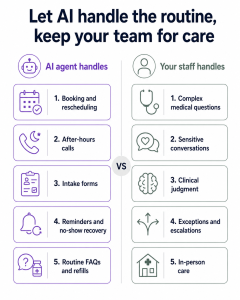
No. It takes over routine calls, forms, and scheduling, and escalates anything sensitive to your team. Your staff spend less time on the phone and more time with patients in the clinic.
Can the agent book directly into our scheduling system?
Yes. A well-integrated agent reads live availability and writes the booking back into your EHR or practice management system in real time, so there is no manual follow-up.
What can patients do by voice or chat?
They can book, reschedule, and cancel visits, complete intake forms, get reminders, and ask routine questions like hours, prep instructions, and lab status, often in more than one language.
How long does it take to set up?
A focused rollout that starts with one workflow, such as after-hours booking, typically goes live in a few weeks. Timelines depend on your systems and how many workflows you automate.
The bottom line for US clinics
Your front desk is the first thing a patient experiences, and right now it is probably leaking calls, bookings, and staff hours. That is not a people problem. It is a systems problem.
AI patient intake and appointment automation fixes it at the source. It answers every call, books patients around the clock, collects intake before the visit, and hands the sensitive work to your team. The result is fewer no-shows, more captured demand, and a front desk that finally keeps up.
Want to see what this would look like for your clinic? Book a free consultation with Appther, and we will map your call flows, your EHR, and your intake process to a clear, compliant plan.