| Quick answer
Odoo for distributors and wholesalers is an ERP setup that connects inventory, purchasing, sales, and accounting in one system. It lets you manage thousands of SKUs across multiple warehouses, automate reordering, and ship orders accurately without spreadsheets or disconnected tools. For US distribution businesses, it replaces manual stock tracking with real-time visibility and rules-based automation that scale as your catalog and order volume grow. |
Picture a Monday morning in a busy distribution warehouse. A customer wants 200 units of your best seller, but nobody can say for sure how many sit on the shelf. The spreadsheet says one thing. The shelf says another. A buyer is already on the phone reordering stock you actually have too much of.
If that feels familiar, you are not alone. This is daily life for distributors and wholesalers who still run on spreadsheets or aging software. The fix is not more staff or more spreadsheets. It is a system built to handle stock the way distribution actually works.
That system is Odoo. In this guide, we look at the specific pains distributors face, how Odoo for distributors and wholesalers solves them, and what a US rollout really involves.
Distribution is a different problem from manufacturing
Most ERP advice treats inventory as a manufacturing topic. Distribution is not the same problem, so it needs a different lens.
A manufacturer turns raw materials into finished goods. The hard part is the production line, the bill of materials, and the shop floor.
A distributor buys finished goods and sells them again. You do not build anything. You move product. So your pain lives somewhere else entirely.
Your margins are thin. Your catalog is huge. Your stock sits across more than one location. And a single picking error can cost you a loyal customer.
Because of that, a distribution ERP needs a different focus from a manufacturing one. The modules overlap, but the priorities do not. If you run a production line instead, our Odoo implementation checklist for manufacturing covers that side in detail.
The SKU and warehouse pains that slow distributors down
Before we look at the fix, let us name the problems. These are the issues we hear most often from US distributors and wholesalers.
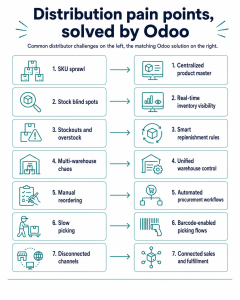
- SKU sprawl: hundreds or thousands of products, variants, units of measure, and supplier codes that never quite match up.
- Stock blind spots: you do not know real quantities until someone physically walks the shelf and counts.
- Stockouts and overstock at the same time: cash is tied up in slow movers while your best sellers run dry.
- Multi-warehouse chaos: stock sits in two or three locations, with no single view across them.
- Manual reordering: purchasing runs on memory, gut feel, and a fragile spreadsheet.
- Slow, error-prone picking: paper pick lists lead to wrong items and short shipments.
- Disconnected channels: a web store, a POS, and phone orders that each track stock on their own.
Any one of these hurts. Together, they cap how big your business can grow. So let us look at how Odoo clears each one.
How Odoo for distributors and wholesalers solves these problems
One system, one source of truth
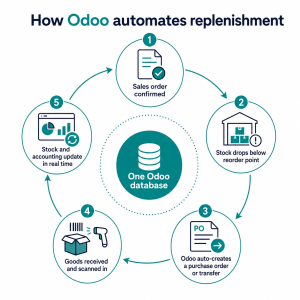
Odoo connects inventory, purchasing, sales, and accounting in a single database. When a sales order is confirmed, stock updates instantly. When stock drops, purchasing knows right away.
You stop reconciling separate systems, because there is only one. This is the core reason distributors move to Odoo. Real-time visibility replaces guesswork.
Multi-warehouse and multi-location control
Odoo handles many warehouses and many locations inside one instance. You can see stock per location, transfer between sites, and set routing rules for how product flows.
For a distributor with a main distribution center and two regional warehouses, that single view is the whole point. You always know what you have and where it sits.
SKUs, variants, and barcodes under control
Odoo gives every product a clean record with codes, barcodes, variants, and units of measure. You can buy in one unit and sell in another, for example buy by the case and sell by the each.
Barcode scanning then speeds up receiving, picking, and counts while cutting human error. Your warehouse moves faster, and your numbers stay accurate.
Automated reordering that thinks for you
This is where distributors win back hours. Odoo lets you set minimum and maximum stock levels per product, per warehouse.
When stock falls below the threshold, the system creates a purchase order or a transfer automatically. Your best sellers stop running dry, and your buyers stop firefighting.
Smarter picking and putaway
Odoo supports removal strategies like FIFO and FEFO, so older or expiring stock ships first. It also supports putaway rules that decide where new stock goes.
On top of that, you can use picking methods like batch, wave, and cluster picking. The result is faster fulfillment and far fewer mistakes on the warehouse floor.
Landed costs and accurate valuation
US distributors that import goods carry freight, duty, and handling costs. Odoo lets you add these landed costs to product value, so your margins reflect reality.
It also supports valuation methods like FIFO and average cost. That keeps your books accurate and your pricing honest, even when supplier costs shift.
Every sales channel, one stock pool
Many distributors now sell through more than one channel. Odoo connects its eCommerce, point of sale, and sales modules to the same inventory.
So a unit sold online cannot also be sold in store. One stock pool, every channel, no oversell, and no awkward calls to cancel an order you cannot fill.
Demand forecasting with Odoo 19
The latest release adds AI-driven, predictive inventory features. Odoo 19 can forecast demand from your real order history and flag what to reorder before you run out. We break down the upgrade in our Odoo 19 vs Odoo 17 guide.
For high-SKU distributors, this is a real shift. Inventory moves from reactive to planned, and planning is where margin lives.
From firefighting to flow: a day in the warehouse
Here is what the change looks like day to day, on the floor where it counts.
Before Odoo, a rush order means someone runs to the shelf to check stock. The buyer guesses the reorder quantity. A picker grabs the wrong variant because the paper list is unclear. Meanwhile, the web store sells a unit that left the building an hour ago.
After Odoo, that same rush order shows live stock on screen. The system already raised a purchase order when stock dipped, so the shelf is full. The picker scans a barcode and the screen confirms the right item. The web store reflects the sale the second it ships.
Same warehouse, same team. The only difference is a system that keeps up with them instead of slowing them down.
What US distributors should plan for
American distribution carries a few wrinkles that ERP buyers in other regions do not face. Plan for these early, not after go-live.
Sales tax across states
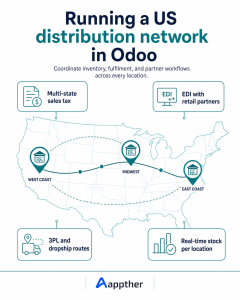
If you sell into multiple states, you likely have tax nexus in several of them. Odoo handles multi-jurisdiction tax rules and integrates with US tax engines, so you charge and report correctly as you expand.
EDI and retail partners
Big-box and grocery buyers often require EDI for purchase orders, invoices, and shipping notices. Odoo connects to EDI providers, so you can trade with these partners without manual data entry.
3PL and dropshipping
Many US distributors use third-party logistics or ship direct from suppliers. Odoo supports dropshipping routes and 3PL integrations, so the system stays accurate even when you never touch the product yourself.
Odoo vs spreadsheets and legacy tools
Most distributors do not start from nothing. They start with spreadsheets, an old system, or a basic accounting tool that has run out of room.
Spreadsheets break the moment two people edit them, and they never show real-time stock. Legacy systems often lock up your data and charge heavily for every change.
Odoo gives you room to grow without that ceiling. If you are weighing it against the bigger suites, our Odoo vs SAP vs NetSuite comparison breaks down where each one fits and what each one costs you over time.
Signs your current setup can no longer keep up
Not sure if it is time to switch? These signals usually mean your tools are holding you back.
- You take a physical count just to trust your stock numbers.
- Two people sell the same unit, and someone has to make an apology call.
- Reordering depends on one person who knows where everything is.
- Adding a warehouse or a sales channel feels impossible.
- Your accounting and your inventory never quite agree.
If you nodded at two or more of these, a distribution-ready ERP will pay for itself quickly.
What an Odoo implementation actually involves
Switching ERP is a real project, not a weekend job. The good news is that a focused distribution rollout is faster than a full manufacturing build.
A typical small to mid-size implementation runs about eight to sixteen weeks. The timeline depends on your SKU count, your data quality, your integrations, and how many warehouses you run.
The work that matters most happens before go-live. Clean your product data. Standardize your SKUs and units of measure. Set accurate opening stock per location. Dirty data is the single biggest reason ERP projects stumble.
You also need role-based training. Your warehouse team, your buyers, and your sales staff each use Odoo differently, so train them for their actual jobs, not a generic overview.
This is where a certified partner earns its keep. Appther runs end-to-end Odoo implementation, customization, and support, with sprint-based delivery so you see working software at every checkpoint. You can explore the full scope on our Odoo services page.
How quickly does Odoo pay off?
Distributors usually see returns from three places. First, you free up cash by cutting overstock and dead inventory. Second, you save the labor hours that used to go into counts, reconciliation, and manual reordering. Third, you keep customers by shipping the right order on time.
Those gains add up fast in a thin-margin business. Many distributors recover the cost of a focused implementation within the first year. The exact payback depends on your volume, your error rate today, and how much stock you carry. A short discovery session is the quickest way to size it for your own numbers.
Frequently asked questions
Can Odoo handle thousands of SKUs?
Yes. Odoo manages large catalogs with variants, barcodes, and multiple units of measure. Performance scales well with proper setup and hosting, so a growing catalog is not a problem.
Does Odoo support multiple warehouses?
Yes. Odoo manages many warehouses and locations in one system, with transfers and routing rules between them and a single view across all of them.
Is Odoo good for wholesale distribution specifically?
Yes. Odoo for distributors and wholesalers covers multi-warehouse stock, automated reordering, multi-channel sales, and landed costs, which are the core needs of any distribution business.
How long does an Odoo implementation take for a distributor?
Most small to mid-size distribution rollouts take about eight to sixteen weeks, depending on SKU count, data quality, and the number of integrations you need.
Should distributors choose Odoo Community or Enterprise?
Most distributors choose Enterprise for features like advanced reporting and official support. That said, the right edition depends on your budget and your feature needs, and a partner can help you decide.
The bottom line for distributors and wholesalers
For a distributor or wholesaler, inventory is the business. When your stock data is wrong, everything downstream breaks, from cash flow to customer trust.
Odoo for distributors and wholesalers fixes that at the root. It puts every SKU, warehouse, and order in one system, then automates the routine work so your team can focus on growth instead of firefighting.
If you manage a growing catalog across more than one location, it is worth a serious look.
Ready to see what a distribution-ready Odoo setup looks like for your business? Book a free discovery session with Appther, and we will map your SKUs, warehouses, and workflows to a clear, fixed-price plan.