| Quick answer
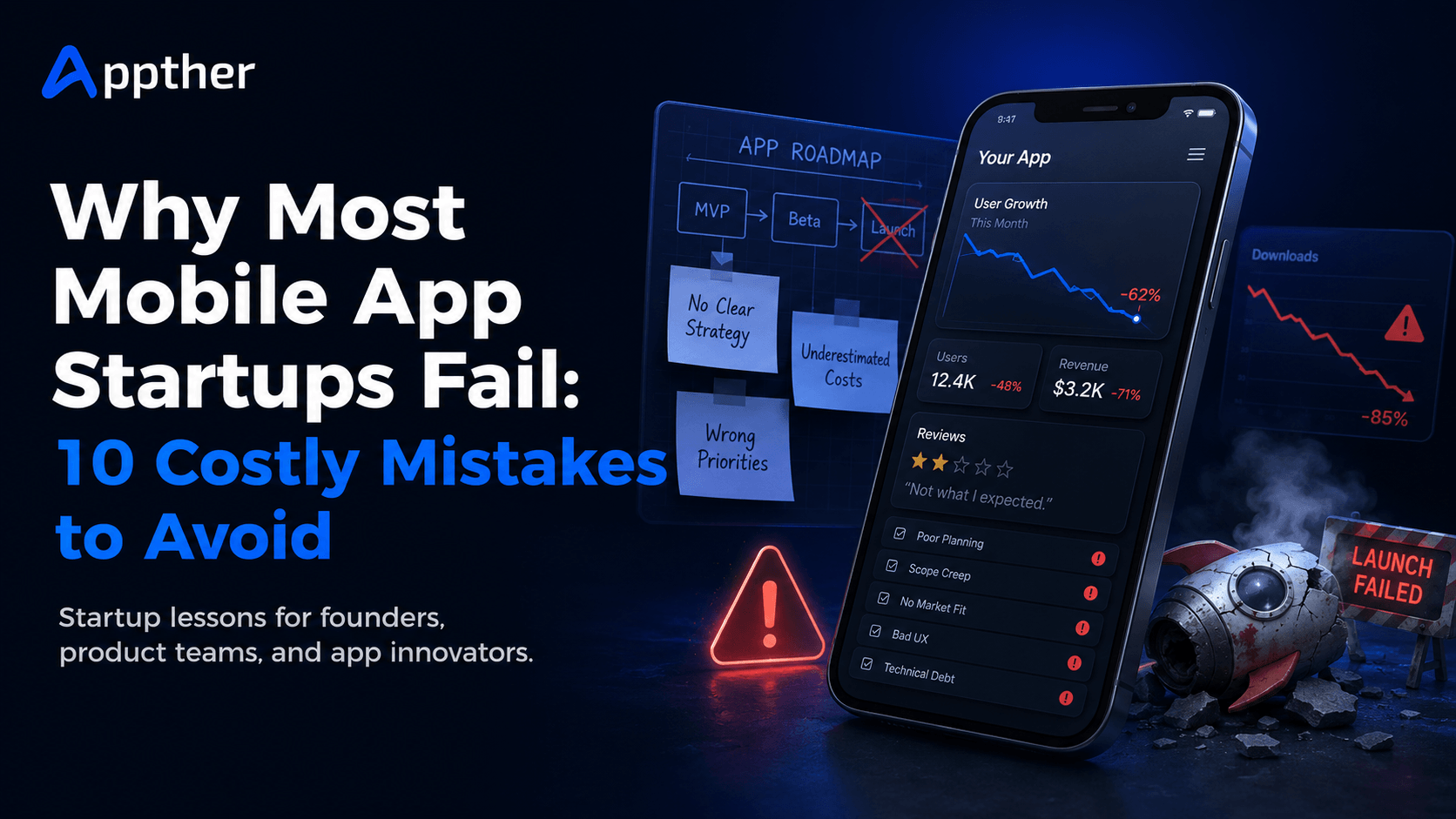
Most mobile app startups fail not because the idea was bad, but because of avoidable mistakes: building without validating demand, skipping the business model, feature bloat instead of an MVP, weak UX, rushed testing, and treating launch day as the finish line. Roughly 90% of startups fail, and about 42% of those failures trace back to building something no market needed. The fixes are known. This guide covers the ten mistakes that kill app startups, grouped by the phase where each one strikes. |
Here is the uncomfortable truth every founder should hear before writing a line of code. Around 90% of startups fail, and the single biggest killer is building something nobody needed. Roughly 42% of failures trace back to a missing market.
The app didn’t crash. The code wasn’t bad. There was simply no one waiting for it.
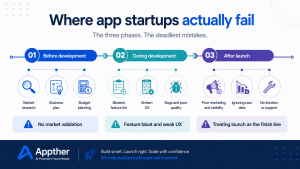
The good news is that app startups rarely die of bad luck. They die of known, repeated, avoidable mistakes. After delivering hundreds of apps for founders and businesses, we see the same ten over and over. They cluster into three phases: before development, during development, and after launch. Miss a phase, and it will find you.
Phase one: mistakes made before a line of code is written
Most doomed apps are doomed before development starts. These first three mistakes are the most expensive because everything built afterwards inherits them.
1. Building without validating demand
This is the killer. Founders fall in love with an idea, assume everyone else will too, and skip straight to development. Passion is not proof.
Without validation, you might be targeting the wrong user, a market too small to matter, or a problem a dozen apps already solve. And you will not find out until the money is spent.
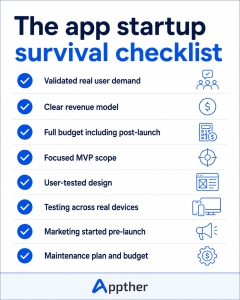
The fix is cheap and unglamorous. Talk to real potential users. Study the competitors and their reviews. Run a landing page test to measure genuine interest. A few weeks of homework can save a six-figure build, because iterating on an idea costs nothing while iterating on code costs everything.
2. Having an app plan but no business plan
A working app is not a business. Many founders obsess over features and never answer the harder questions. Who pays? How much? What does a user cost to acquire, and what are they worth over time?
Studies of failed startups keep finding the same thing: the majority focused on building the product instead of the business model around it. Decide your revenue model early, whether that is subscriptions, transactions, freemium, or something else, because it shapes the product itself. A subscription app and an ad-funded app are built differently from day one.
3. Underestimating the real cost and timeline
First-time founders routinely budget for development and nothing else. The design, the testing, the marketing, the infrastructure, and the ongoing maintenance all arrive later as surprises. Maintenance alone typically runs 15 to 20% of the original build cost every year.
Get honest numbers before you start, including what happens after launch. As a reference point, a simple app starts around US$20,000 to $35,000, a mid-complexity build with backend and integrations runs $35,000 to $80,000, and enterprise platforms go well beyond that, as we break down on our Android app development page. Then plan your runway so launch day is the midpoint of your budget, not the end of it.
Phase two: mistakes made during development
You validated the idea and planned the business. The next four mistakes happen while the product takes shape, and they decide whether users stay or uninstall.
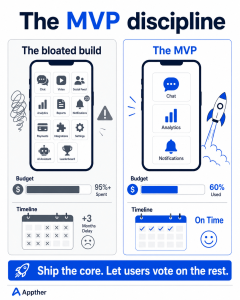
4. Building everything instead of an MVP
Feature bloat is the most seductive mistake on this list. Every feature feels essential, so version one swells, the budget swells with it, and launch slips by months.
Worse, a bloated first release confuses users and buries the core value. The discipline that works is the Minimum Viable Product: the smallest version that tests your core promise. Name the two or three features that prove your value proposition, ship those, and let real user feedback decide what comes next. Everything you cut from version one is money saved for features users actually ask for.
5. Treating design as decoration
Founders often prioritise functionality and treat UI/UX as a paint job at the end. Users see it the other way around. They judge your app in seconds, and a confusing flow or cluttered screen sends them straight to the uninstall button, no matter how clever the engineering underneath.
Invest in the user journey early. Prototype, test with real users, and refine before you build, because a design change on paper costs a fraction of the same change in code. Focus your best design effort on the two or three flows that drive your revenue: onboarding, the core task, and payment.
6. Rushing or skipping real testing
Crashes are lethal. App crashes drive the large majority of uninstalls, and early reviews are unforgiving. A buggy launch can bury an app before it ever gets a fair hearing.
Testing has to cover more than “it works on my phone.” That means functional, performance, security, and usability testing across real devices and OS versions, plus a beta round with genuine users in the final stretch. Beta testers catch the problems your team has gone blind to.
7. Ignoring security, compliance, and scale until later
Security holes like weak authentication, unencrypted data, and hardcoded keys destroy user trust and can end a young company overnight. Privacy rules such as GDPR and CCPA apply to startups too, and app stores enforce their own standards.
Scalability is the quieter twin of this mistake. An architecture that works for a thousand users can collapse at a hundred thousand, right when success arrives. Build on scalable cloud foundations and bake security in from the first sprint, because both are far cheaper to include than to retrofit.
Phase three: mistakes made after launch
Launch day feels like the finish line. It is actually the starting gun, and these last three mistakes are where funded, well-built apps still quietly die.
8. Starting marketing on launch day
With millions of apps in the stores, “build it and they will come” is a fantasy. The most common version of this mistake is starting promotion after release, when momentum matters most.
Marketing should begin before the app ships: a landing page collecting emails, early social presence, outreach to communities where your users already gather. And do not neglect app store optimisation. Your title, keywords, screenshots, and reviews decide whether anyone finds you at all. Budget for acquisition as seriously as you budgeted for development.
9. Launching blind, without analytics or feedback loops
You cannot improve what you cannot see. Startups that skip analytics fly blind, guessing at why users churn instead of knowing.
Instrument the app from day one. Track activation, retention, and the drop-off points in your core flows. Read the reviews, run short surveys, and treat every complaint as free product research. The startups that win are rarely the ones with the best first version. They are the ones that learn the fastest after it.
10. Abandoning the app after release
An app is a living product. New OS versions ship, devices change, libraries update, and competitors move. Without maintenance, even a great app decays into crashes and one-star reviews within months.
Plan for it from the start: reserve that 15 to 20% annual maintenance budget, schedule regular updates, and keep a small slice aside for improvements rather than pure upkeep. If the budget feels daunting, there are proven ways to keep costs down without cutting quality, which we cover in our guide on tactics to reduce the cost of mobile app development.
The pattern behind all ten mistakes
Look back across the list and one theme repeats. Every mistake is a version of skipping the unglamorous work: validation, planning, testing, maintenance. Founders skip these steps to move faster, and each skipped step quietly compounds into the failure statistic.
The founders who beat the odds are not smarter. They are more disciplined. They validate before they build, ship small and learn fast, and treat launch as the beginning. None of it is secret. It is just consistently done.
What the surviving 10% do differently
It helps to flip the question. Instead of only avoiding mistakes, copy the habits of the startups that make it.
They talk to users constantly, before, during, and after the build, so the product is shaped by evidence rather than opinion. They ship early and small, treating version one as a question rather than a statement. They measure everything that matters and let retention, not downloads, define success, because downloads are vanity while retention is survival.
They also protect their runway. Surviving founders keep enough budget after launch to market, learn, and iterate for months, because the first version is almost never the one that wins. And they choose partners and hires who have shipped before, buying pattern recognition instead of learning every lesson at full price.
None of these habits require genius. They require the humility to test your assumptions and the patience to keep improving after the applause of launch day fades.
How the right development partner changes the odds
Most of these mistakes are invisible to a first-time founder and obvious to a team that has shipped hundreds of apps. That is the real argument for an experienced partner: not just code, but pattern recognition.
Appther has delivered mobile apps for startups and enterprises across healthcare, fintech, logistics, and eCommerce. Our process is built to catch these mistakes early: a discovery phase that pressure-tests the idea and the business model, an MVP-first roadmap with fixed-price clarity, security and scalability designed in from the first sprint, and post-launch support so the app keeps improving after release. You can hire dedicated developers for your stack, or start with a conversation about the idea itself.
Frequently asked questions
Why do most mobile app startups fail?
The leading cause is building something without market need, which accounts for roughly 42% of startup failures. Other major causes include running out of budget, weak user experience, poor testing, and no marketing or maintenance plan after launch.
What is the biggest mistake first-time app founders make?
Skipping validation. Founders assume demand instead of proving it, then discover the market gap only after the money is spent. Cheap validation, through user interviews, competitor research, and landing page tests, prevents the most expensive failure.
How much should a startup budget for a mobile app?
A simple app typically starts around US$20,000 to $35,000, with mid-complexity builds running $35,000 to $80,000. Add marketing, infrastructure, and 15 to 20% of the build cost per year for maintenance, so launch is the midpoint of your budget, not the end.
What should be in a mobile app MVP?
Only the two or three features that prove your core value proposition, built well. Everything else waits for user feedback. A focused MVP launches faster, costs less, and tells you what users actually want before you spend on the rest.
How important is post-launch maintenance?
Critical. New OS versions, device changes, and security updates arrive constantly, and an unmaintained app decays into crashes and bad reviews within months. Plan roughly 15 to 20% of the original development cost per year for upkeep.
The bottom line
Apps do not fail randomly. They fail at predictable points, for predictable reasons, and every one of the ten mistakes above has a known fix. Validate before you build. Plan the business, not just the app. Ship a focused MVP, test it properly, and keep investing after launch.
Do that, and you are no longer competing against the odds. You are competing against founders who skipped the steps you didn’t.
Have an app idea you want pressure-tested before you spend a dollar on development? Book a free discovery session with Appther, and we will help you validate the idea, scope a lean MVP, and map a realistic budget from build through launch.