| Quick answer
To choose an AI app development agency in Australia, judge candidates on six things: proof of AI systems running in production, engineering depth across both apps and AI, Australian Privacy Principles compliance with onshore data options, real working-hour overlap with your team, transparent pricing with full IP ownership, and post-launch support for models that keep learning. Expect a simple AI-powered app to start around AUD 20,000 to 50,000, and treat any agency that cannot show shipped AI work as a risk, not a bargain. |
Australia’s AI moment has well and truly arrived. The local AI market has passed the four billion dollar mark, the federal government is pushing adoption through its National AI Capability Plan, and businesses from Sydney fintechs to Perth mining services are racing to build AI into their products.
That rush has created a new problem. Every app agency now calls itself an AI agency. Some have genuinely shipped machine learning systems into production. Others have wrapped a chatbot around an API and updated their homepage. From the outside, the two look identical.
This guide shows you how to tell them apart. We cover what a real AI app development agency in Australia should offer, what it costs, the questions that expose weak candidates, and the red flags to walk away from.
What an AI app development agency actually does
It helps to be precise, because three different services get blurred together.
A traditional app agency builds mobile and web applications: the screens, the backend, the store submissions. An AI consultant advises on strategy, use cases, and governance, but usually does not build. An AI app development agency does both jobs at once. It designs and ships real applications with intelligence built into them, whether that is an LLM-powered assistant, a computer vision feature, a recommendation engine, or an autonomous agent.
That dual skill set is the whole point, and it is rarer than the marketing suggests. Plenty of agencies can build an app. Plenty of data scientists can train a model. The hard part is the marriage: putting AI inside production software that stays fast, accurate, and reliable when real users arrive.
Why the choice is riskier with AI than with a normal app build
Choosing badly always hurts, but AI raises the stakes in three specific ways.
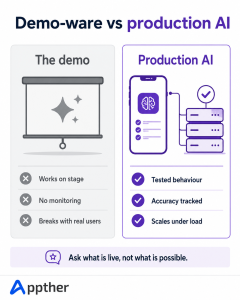
First, demos deceive. An impressive AI prototype is genuinely easy to build now, and genuinely hard to turn into a production system. The gap between the two is where most AI projects die, and you cannot see that gap in a sales meeting.
Second, AI-assisted coding has flooded the market with shallow capability. Industry research suggests the large majority of AI-generated code needs significant human review before it is production-ready. An agency leaning on these tools without senior engineering judgement ships fragile software, and you find out after launch.
Third, the compliance surface is bigger. An AI app touches more data, makes more decisions, and carries more privacy obligations than a standard app. In Australia, that lands directly on you, the business, not just the vendor.
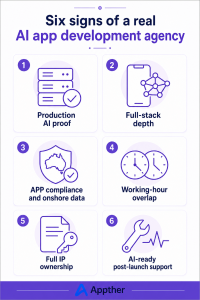
Six criteria that separate real AI agencies from rebranded ones
1. AI systems live in production, not just case study pages
Ask every candidate one question first: show me an AI feature you built that real users depend on today. Then dig in. What model does it use? How is accuracy monitored? What happened when it got things wrong? An agency that has genuinely shipped AI answers with specifics and war stories. A rebranded one answers with slideware.
2. Full-stack depth: the app and the AI
Your product needs both halves done well. On the app side, that means native and cross-platform experience with tools like Swift, Kotlin, Flutter, and React Native. On the AI side, it means real work with LLMs, RAG pipelines, machine learning frameworks like TensorFlow and PyTorch, and the cloud infrastructure underneath. Agencies that outsource one half to a third party add cost, delay, and finger-pointing when something breaks.
3. Australian Privacy Principles compliance and onshore data options
AI apps consume data, so privacy is not a paperwork step, it is architecture. Your agency should design around the Privacy Act and the Australian Privacy Principles from day one, offer onshore hosting in Australian regions such as AWS Sydney where your sector demands it, and guarantee that your private data never trains public AI models. If you serve health, finance, or government customers, treat this criterion as non-negotiable.
4. Genuine working-hour overlap
AI projects involve constant decisions: model trade-offs, data questions, behaviour reviews. Those conversations cannot wait a full day for the other side of the world to wake up. Look for an agency whose team genuinely overlaps Australian business hours for stand-ups and reviews, whether through local presence or a delivery centre in a nearby time zone.
5. Transparent pricing and full IP ownership
You should know what you are paying for, and you should own everything you paid for: the code, the fine-tuned models, the prompts, and the data pipelines. Insist on clear work-for-hire terms and signed NDAs. Any agency that wants to keep your models or lock you into its platform is building leverage over you, not software for you.
6. Post-launch support built for AI
AI systems are not fire-and-forget. Models drift as the world changes, costs need tuning, and behaviour needs monitoring. A serious agency offers ongoing MLOps support: accuracy tracking, retraining, prompt and model updates, and cost optimisation. If post-launch support is an afterthought in the proposal, the agency has not run production AI for long.
What AI app development costs in Australia
Prices vary with scope, but the Australian market has settled into recognisable bands. A simple AI-powered app, for example an app with a smart assistant or basic personalisation, typically starts around AUD 20,000 to 50,000. Mid-complexity builds with custom models, integrations, and a proper backend commonly run into six figures. Enterprise systems with deep machine learning, computer vision, or heavy compliance can exceed AUD 150,000.
Timelines follow the same logic. A focused AI MVP usually ships in 8 to 12 weeks, while advanced applications take four to six months or more.
Two cost notes worth keeping in mind. First, AI apps carry ongoing model and infrastructure costs that a normal app does not, so ask every candidate to estimate monthly running costs, not just the build. Second, a hybrid agency, with Australian-hours leadership and a global engineering centre, often delivers the same senior quality at a meaningfully lower rate than a purely local team. Judge the process and the proof, not the postcode.
Questions to ask before you sign
Take these into your first meetings. Strong agencies enjoy these questions. Weak ones deflect them.
- Which AI systems have you shipped that are in production right now, and can I speak to the client?
- How do you decide between calling an existing model, fine-tuning, or building custom?
- How will you keep our data compliant with the Australian Privacy Principles, and can it stay onshore?
- What does your testing look like for AI behaviour, not just app functionality?
- Who owns the code, prompts, and models when we part ways?
- What will this cost to run monthly after launch, and how do you monitor accuracy and drift?
Red flags that should end the conversation
- Every answer is a demo, and no production system is ever named.
- AI is promised as a solution before anyone has asked about your data.
- Vague or evasive answers on privacy, data location, or model training.
- No mention of ongoing model monitoring or post-launch costs.
- The agency keeps ownership of models, prompts, or your data.
- Pressure to commit to a large build before a discovery phase or pilot.
One more that is easy to miss: an agency that says yes to everything. Real AI engineers push back, because some ideas do not need AI at all, and some data cannot support the ambition. Honest friction early is a feature, not a flaw.
Agency, freelancer, or in-house: a quick reality check
An agency is not the only path, so it is worth being honest about the alternatives.
Hiring in-house gives you the most control, but AI engineers are among the scarcest and most expensive hires in Australia, and a single hire cannot cover design, mobile, backend, and machine learning at once. Freelancers work for small, well-defined tasks, but AI apps are multi-disciplinary by nature, and coordination across several freelancers becomes your full-time job.
An agency gives you the full team, the delivery process, and the accountability in one contract. For most Australian businesses building their first serious AI product, it is the fastest route to production, provided you choose with the criteria above.
A simple process for making the choice
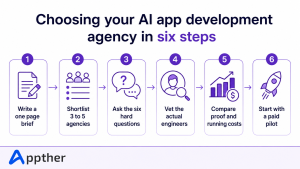
Pulling it all together, here is a sequence that works.
Start by writing a one-page brief: the problem, the users, the data you hold, and what success looks like in numbers. Then shortlist three to five agencies using directories, referrals, and comparison guides, filtered for shipped AI work and Australian-market experience.
Put every shortlisted agency through the six questions above, and technically vet the actual team, not just the salesperson. Compare proposals on proof, process, and running costs rather than the headline rate. Then start the winner on a discovery phase or a small paid pilot before committing to the full build. Two to four weeks of discovery costs little and removes the most expensive risk of all, which is building the wrong thing confidently.
Where Appther fits
Appther is an AI-first software development company, founded in 2018, that builds exactly this combination: intelligent chatbots, machine learning models, computer vision, and generative AI, inside production-grade iOS, Android, and cross-platform apps. A team of 50 to 100 engineers has delivered more than 200 projects across healthcare, manufacturing, real estate, logistics, and iGaming, in over a dozen countries including Australia.
The delivery model matches what Australian buyers need. Leadership and accountability sit in a structure that overlaps Australian hours, engineering runs through a dedicated centre that keeps costs sensible, and every engagement comes with full IP ownership, signed NDAs, and flexible models from fixed-price to dedicated teams. An AI MVP typically ships in 8 to 12 weeks.
You can see the full capability on our AI development services page and our Android app development page. And if you are still building your shortlist, our guides to the top AI development companies in Australia and the top AI-integrated mobile app developers in Australia are a useful place to compare options side by side.
Frequently asked questions
How much does it cost to hire an AI app development agency in Australia?
A simple AI-powered app typically starts around AUD 20,000 to 50,000, mid-complexity builds run into six figures, and enterprise systems can exceed AUD 150,000. Always ask for the estimated monthly running cost as well, since AI apps carry ongoing model and infrastructure expenses.
How long does an AI app take to build?
A focused AI MVP usually ships in 8 to 12 weeks. Advanced applications with custom models, complex integrations, or heavy compliance take four to six months or more.
Does the agency need to be physically based in Australia?
No, but it needs to work like it is. Genuine overlap with Australian business hours, Australian Privacy Principles compliance, and onshore data options matter far more than the office address. Many strong agencies pair Australian-hours leadership with a global engineering centre.
What is the difference between an AI consultant and an AI app development agency?
A consultant advises on strategy, use cases, and governance. An AI app development agency designs, builds, and ships the actual product. Many businesses use a consultant to shape the plan and an agency to deliver it, and some firms offer both.
What should I check before signing with an AI agency?
Verify production AI proof, full-stack capability, privacy compliance with onshore options, working-hour overlap, transparent pricing with full IP ownership, and AI-specific post-launch support. Then de-risk the start with a discovery phase or a small paid pilot.
The bottom line
Australia is full of agencies that say AI. Far fewer can ship it. The difference is invisible in a pitch deck and obvious in production, so make the invisible visible: demand live systems, interrogate the data and privacy story, insist on ownership, and start small before you scale.
Choose on those terms and you will not just get an app with AI in it. You will get a partner who can keep improving it as the technology, and your business, moves.
Ready to pressure-test your AI app idea? Book a free consultation with Appther, and we will map your use case, your data, and your compliance needs to a clear plan, with an MVP typically live in 8 to 12 weeks.