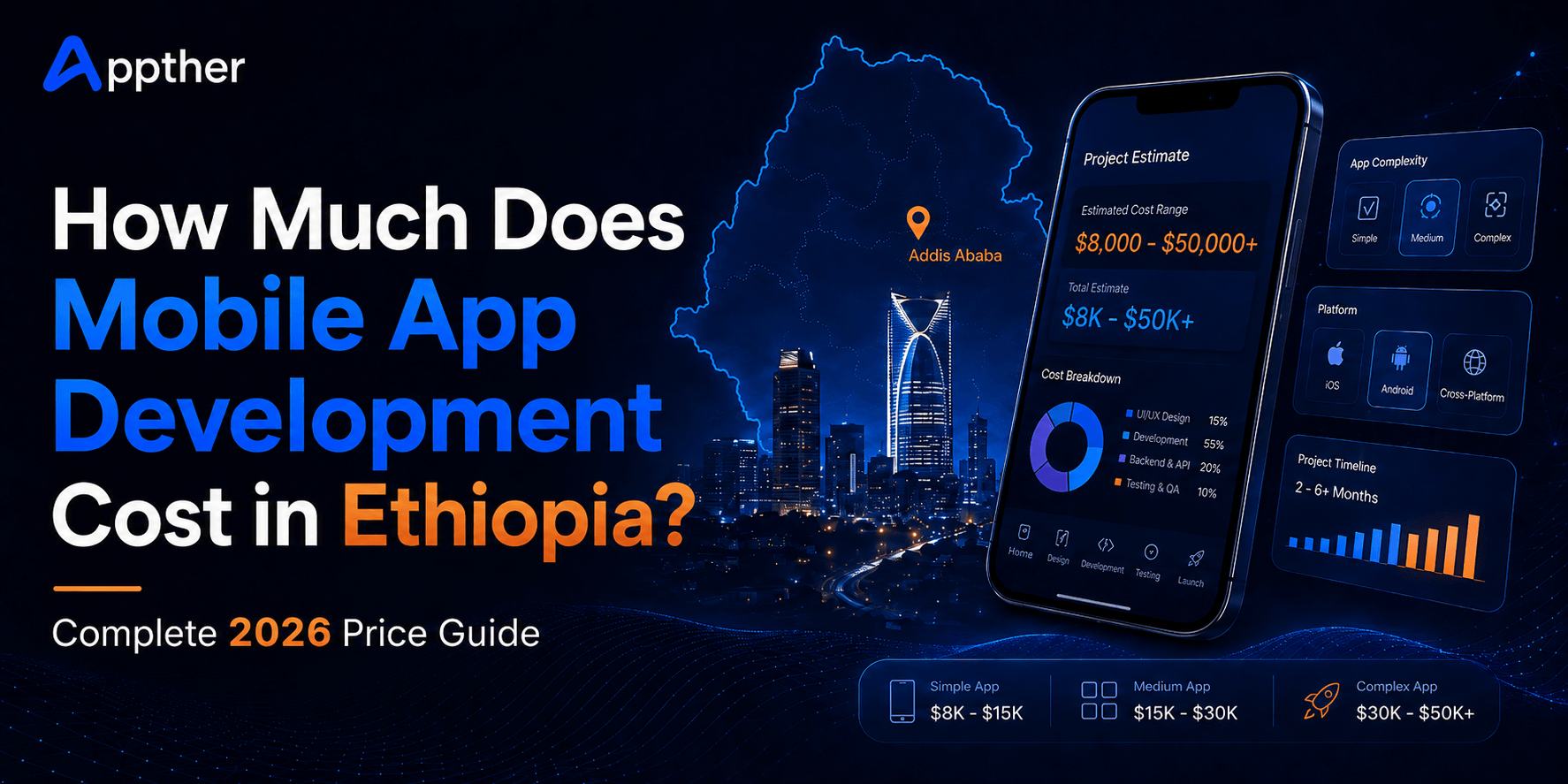
If you are a business owner in Addis Ababa or anywhere in Ethiopia, the first question you probably ask when planning a mobile app is also the hardest one to get a straight answer to. How much will it actually cost? Some agencies quote a few thousand dollars, others quote ten times that for what sounds like the same app, and most websites avoid putting any numbers in writing at all.
This guide fixes that. We will break down the real mobile app development cost in Ethiopia in 2026, explain exactly what drives the price up or down, show you typical budgets by app type, uncover the hidden costs most agencies forget to mention, and share practical ways to build a great app without burning your entire budget.
One quick note before we begin. If you are still comparing agencies, our guide to the top 10 mobile app development companies in Addis Ababa is a good companion read to this one. Pricing and partner selection go hand in hand.
The Quick Answer: Mobile App Development Cost in Ethiopia at a Glance
In 2026, mobile app development cost in Ethiopia typically ranges from $3,000 for a simple business app to $100,000 or more for a complex enterprise platform. Most small and medium businesses in Addis Ababa end up spending between $8,000 and $30,000 for a well built app with a custom backend and local payment integration.
Here is a summary of what businesses can expect to pay in 2026:
| App Type | Estimated Cost (USD) | Timeline |
| Simple business app | $3,000 to $10,000 | 6 to 10 weeks |
| Medium complexity app | $10,000 to $30,000 | 3 to 5 months |
| Complex or enterprise app | $30,000 to $100,000+ | 6 to 12 months |
| E-commerce app | $8,000 to $35,000 | 3 to 6 months |
| Fintech or payment app | $20,000 to $80,000+ | 4 to 9 months |
| On-demand delivery app | $15,000 to $50,000 | 4 to 7 months |
Most agencies serving the Ethiopian market quote in US dollars because the birr exchange rate fluctuates, so we have used USD throughout this guide. Always confirm with your development partner whether quotes are fixed in dollars or birr, and what happens to pricing if the project timeline extends.
What Actually Drives Mobile App Development Cost?
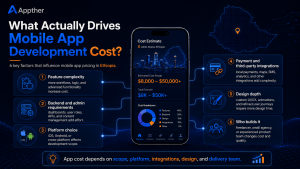
Two apps that look similar on screen can have wildly different price tags. Here is why. The cost of your app is determined far more by what happens behind the screen than by what users see on it. These are the six factors that matter most:
- Feature complexity. A catalogue app that displays your products is cheap. An app with user accounts, real-time chat, GPS tracking, push notifications, and payments is a different animal entirely. Every feature adds design, development, and testing hours.
- Backend and admin requirements. Most serious apps need a server, a database, APIs, and an admin dashboard where your team manages content, orders, or users. The backend often costs as much as the app itself, and it is the part clients most frequently underestimate.
- Platform choice. Building separate native apps for Android and iOS nearly doubles the work. Cross-platform frameworks like Flutter and React Native let one codebase serve both platforms, which is why most Ethiopian projects now take this route.
- Payment and third-party integrations. Integrating Telebirr, CBE Birr, or international gateways takes specialist work, especially around security and transaction handling. The same goes for SMS gateways, maps, and analytics tools.
- Design depth. Template-based design is fast and affordable. Custom UI/UX design tailored to your brand and tested with real users costs more but dramatically improves how many people keep using your app after downloading it.
- Who builds it. A freelancer, a small local shop, and an established agency with senior engineers will quote very different numbers for the same brief, and the differences usually show up in code quality, communication, and what happens after launch.
Cost Breakdown by App Type
Simple Business Apps ($3,000 to $10,000)
These are apps with a handful of screens and limited backend needs. Think of a restaurant menu and reservation app, a company profile app with a contact form, or a basic booking tool. They typically take 6 to 10 weeks to build and are a sensible starting point for businesses testing whether their customers will actually use an app.
Medium Complexity Apps ($10,000 to $30,000)
This is where most Ethiopian business apps land. You get user registration and login, a custom backend with an admin panel, push notifications, payment integration, and polished custom design. Examples include e-commerce apps for retail shops, appointment systems for clinics, and loyalty apps for hospitality businesses. Expect 3 to 5 months from kickoff to launch.
Complex and Enterprise Apps ($30,000 to $100,000+)
Apps in this tier involve multiple user roles, real-time features, heavy integrations, and serious scale requirements. Ride-hailing platforms, multi-vendor marketplaces, banking apps, and logistics systems with live tracking all sit here. Fintech apps in particular carry extra cost because of security, compliance, and fraud-prevention requirements that simply cannot be skipped when the app handles money.
AI-Powered Apps (Varies, Often $15,000 to $60,000+)
A fast-growing category in Ethiopia is apps with built-in AI features such as chatbots, recommendation engines, and voice assistants. Ethiopian banks and service businesses are already adopting AI-powered chatbots that handle customer service in Amharic, and the same technology can be embedded directly into your mobile app. AI features add cost upfront but often pay for themselves quickly by reducing support staff workload and keeping customers engaged around the clock.
Where the Money Actually Goes: Cost by Development Stage
Understanding how a budget gets distributed helps you evaluate quotes intelligently. A typical project breaks down roughly like this. Discovery and planning takes about 5 to 10 percent of the budget, covering requirements, wireframes, and the technical roadmap. UI/UX design takes 15 to 20 percent. Core development is the biggest slice at 45 to 55 percent, split between the app itself and the backend. Quality assurance and testing takes 15 to 20 percent, and deployment plus launch setup takes the remaining 5 to 8 percent.
If an agency quote skips testing or treats it as optional, walk away. Untested apps cost far more to fix after launch than they would have cost to test properly before it.
Local Agencies vs International Partners: How Rates Compare
Hourly rates vary significantly depending on where your development team sits. Local Ethiopian developers and small agencies typically charge $15 to $35 per hour. Established agencies in India and similar outsourcing hubs charge $20 to $50 per hour with deeper specialist benches. Western European and North American agencies charge $80 to $200 per hour for comparable work.
For most Ethiopian businesses, the sweet spot is a partner that combines competitive rates with senior engineering talent and genuine experience in the Ethiopian market. This is exactly the model Appther operates on. The company has delivered 500+ projects across 40+ countries, including work for businesses targeting Addis Ababa, and its mobile app development services cover everything from MVP builds to enterprise platforms, with AI engineering and ERP integration available under the same roof when your app needs to connect to broader business systems.
The Hidden Costs Nobody Tells You About
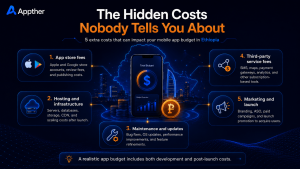
The development quote is not the full picture. Budget for these ongoing costs from day one so they never catch you by surprise:
- App store fees. Google Play charges a one-time $25 developer fee. Apple charges $99 per year. Small amounts, but mandatory.
- Hosting and infrastructure. Cloud hosting for your backend typically runs $20 to $300+ per month depending on user volume. Apps with real-time features or heavy media cost more.
- Maintenance and updates. Plan for 15 to 20 percent of the original development cost per year. Operating systems update, devices change, and bugs surface. An unmaintained app slowly breaks.
- Third-party service fees. SMS verification, push notification services, map APIs, and payment gateway transaction fees all carry recurring charges that scale with usage.
- Marketing and launch. The app stores will not promote your app for you. Set aside a real budget for launch marketing, because an excellent app nobody downloads delivers zero return.
How Much Does Telebirr Integration Cost?
This deserves its own section because almost every Ethiopian business asks about it. Integrating Telebirr or CBE Birr into your app typically adds $1,500 to $5,000 to the project depending on the complexity of your transaction flows, refund handling, and reconciliation requirements. The bigger cost driver is experience. A team that has done local payment integration before will complete it in a fraction of the time a first-timer needs, and will handle edge cases like failed transactions and network timeouts properly. Always ask your shortlisted agencies to show you a live app where they have integrated Ethiopian payment systems.
Seven Smart Ways to Reduce Your App Development Cost
- Start with an MVP. Launch with the core features that prove your idea works, then add the rest based on real user feedback. This approach can cut initial costs by half and prevents you from paying for features nobody uses.
- Go cross-platform. Flutter or React Native gives you Android and iOS from one codebase at roughly 60 to 70 percent of the cost of two native apps.
- Prioritize Android first. Android dominates the Ethiopian market, so if budget is tight, launch on Android and add iOS once revenue starts flowing.
- Write down your requirements. Scope changes mid-project are the single biggest cause of budget overruns. A clear, documented feature list before development starts protects both you and your agency.
- Use proven building blocks. Ready-made solutions for authentication, notifications, and analytics are cheaper and more reliable than building everything from scratch.
- Phase your AI features. Launch the core app first, then add chatbots or recommendations in version two once you have user data to power them.
- Get a detailed proposal, not just a number. A serious agency will break the quote down by phase and feature. Vague lump-sum quotes almost always hide either padding or corners that will be cut.
Frequently Asked Questions
How much does it cost to build a simple app in Ethiopia?
A simple app with a few screens and basic functionality typically costs $3,000 to $10,000 in 2026. The price climbs once you add user accounts, payments, or a custom admin dashboard.
Is it cheaper to hire a freelancer or an agency?
Freelancers cost less per hour but carry real risk on anything beyond simple projects. One person rarely covers design, frontend, backend, testing, and deployment well, and if they disappear mid-project, you start over. Agencies cost more but bring full teams, accountability, and post-launch support.
How long does app development take?
A focused MVP typically ships in 8 to 14 weeks. Full-featured products take 4 to 7 months. Complex enterprise platforms can run 9 to 12 months. Clear requirements at the start are the single biggest factor in keeping timelines short.
Do I pay everything upfront?
No reputable agency asks for full payment upfront. The standard model is milestone-based payments tied to deliverables, often starting with 20 to 30 percent at kickoff. This protects you and keeps the agency motivated to hit deadlines.
What is the cheapest way to get a quality app?
Start with a cross-platform MVP focused on Android, integrate only the payment method your customers already use, and choose a partner with proven Ethiopian market experience so nothing has to be built twice.
Final Thoughts: Budget for Value, Not Just Price
The cheapest quote is rarely the cheapest app. Businesses that choose purely on price often end up paying twice, first for the broken version and then for the rebuild. The smarter approach is to define your requirements clearly, get detailed proposals from two or three credible partners, and judge them on portfolio quality, payment integration experience, and post-launch support rather than the bottom-line number alone.

If you want a precise budget for your specific idea, Appther offers a free consultation where the team reviews your requirements, suggests the right scope for your budget, and gives you a transparent, milestone-based proposal with no obligation. You can also browse the portfolio of 500+ delivered projects to see the quality of work before you ever pick up the phone. Whatever partner you choose, walk in with the knowledge from this guide and you will negotiate from a position of strength.